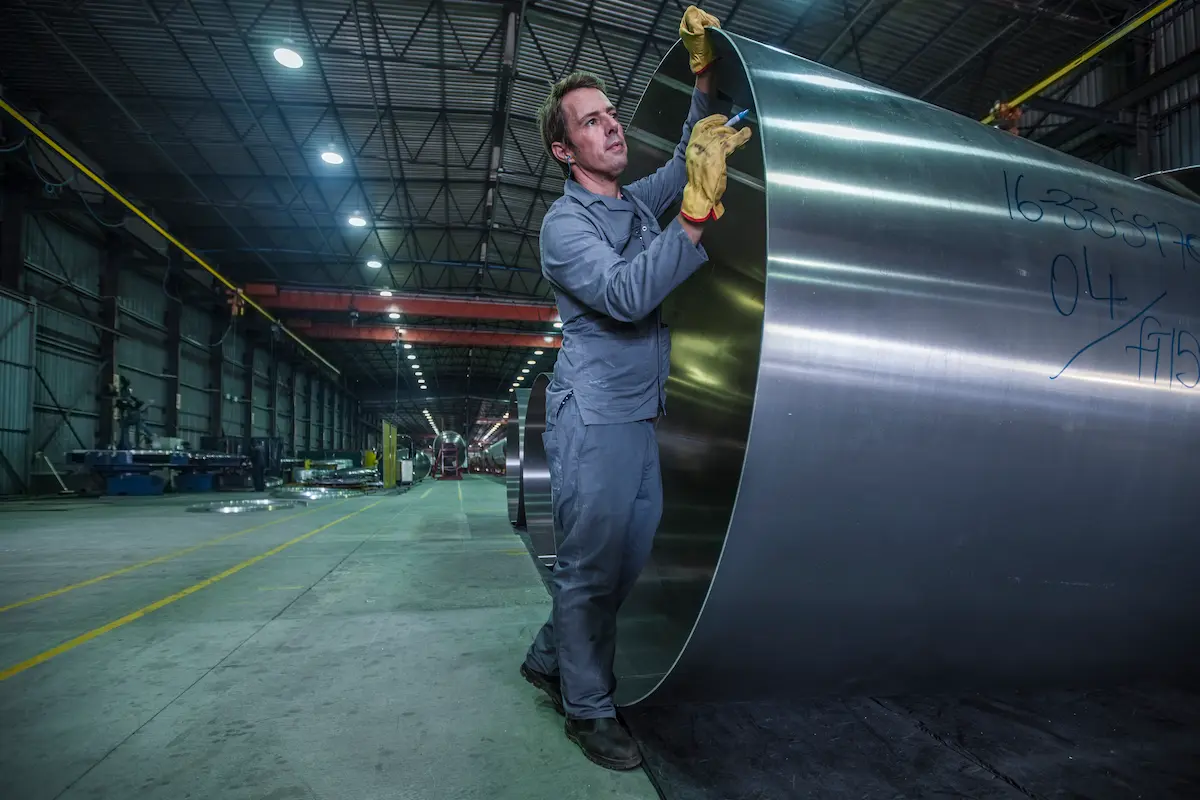
Calendered sheet metal development between bending radius calculation and bending table
The development of the calendered sheet is the basis for properly designing virole, cylindrical shells, curved crankcases and components with complex geometries, because on that value depend the accuracy of the fit, the quality of the weld and the dimensional stability of the finished part. In practice, calculating the development means deriving the “stretched” length of the sheet that, after calendering and bending, will have to close the required diameter taking into account the bend radius, material and K-factor; therefore, a sheet metal bending table becomes the operational tool that connects theory and production, reducing bench tests, rework and scrap.
Understand calendering and sheet metal bending in development
When people talk about sheet metal development they often think only of angle bending on a press brake, but in the reality of metalwork the situation is more complex, because parts almost always combine straight and curved sections generated in laser cutting, calender and bending machine.
In sheet metal calendering, the deformation is distributed along the arc and the radius is not concentrated in a hinge as in the classic V-bend, so the neutral layer is arranged differently and the development must be calculated keeping in mind both the geometry of the curve and the contributions of any subsequent or previous bends, which may change the behavior of the material in the calendering zone.
This is why it is useful to distinguish from the outset the part of the component obtained by sheet metal bending on a press brake from that created in a calender: in the former case, the deformation is localized and we reason in terms of internal radius, K factor and bend deduction; in the latter case, we work on the development of an arc or cylinder as a function of the average radius and angle of wrap.
In shop-floor practice, the final development of a virola or curved shroud results from the combination of these two approaches, which must be consistent with each other and with the available technologies, such as the press brakes and calenders used in the production cycle.
Difference between angle bending and calendering
In angle bending, the sheet is pushed by a punch into a die, generating a relatively narrow bending zone with an inner radius that depends on the tool, slot opening, and thickness; the developed length is calculated by summing the straight parts and subtracting or adding a bend deduction derived from formulas or tables. In calendering, on the other hand, the sheet passes several times between opposing rollers and the deformation is distributed over a wider section, so the radius of curvature is governed by the position of the rollers and the development coincides with the arc of the cylinder or truncated cone to be obtained, to which any straight edges to be bent later are added.
This means that while a press brake works primarily on angle control and internal radius in a confined area, the calender handles continuous radius and progressive bending, where development errors immediately result in nonconforming diameters, excessive clearance or overlapping at the time of welding. In a complete cycle such as one that places sheet metal working, calendering and welding side by side, control of these aspects is an integral part of product industrialization and not simply a shop floor detail.
Parameters governing development
The parameters that determine the development of a calendered and folded sheet metal are essentially material thickness, inner bending radius, calendering radi us (or mean radius of virola), material type with its elastic modulus, and the sequence of processing. For operational clarity, the factors that directly influence development are:
- Sheet thickness and position of the neutral layer;
- Inner radius of the fold obtained in press-folding;
- Calendering radius set on the rollers;
- material and rolling direction with respect to the strain line;
- Springback depending on alloy and machine settings;
- Sequence of steps: cutting, calendering, bending, welding.
Alongside these factors, it is essential in design and production practice to take into account springback and rolling direction, because both change the behavior of the sheet metal in bending and curving. Consistent management of these parameters, integrated with the available fleet of machines and product industrialization criteria, makes it possible to define repeatable and stable developments, reducing rework and adjustment times.
Calculation of development for calendered sheet metal
The calculation of the development starts from the concept of the neutral layer, which is that ideal surface within the thickness that neither elongates nor shortens during bending; the length of this layer is what is taken as a reference for the total development of the part. In angle bending, the neutral layer is approximated by the so-called K-factor, which expresses the position of the neutral layer with respect to the thickness and makes it possible to determine the length of the bend arc to be added to the straight parts, while in calendering the same principle is applied to a wider arc, often corresponding to a cylindrical section or a complete virola.
From the folding model to the case of calendering
In classical fold modeling, the part is broken down into two straight sections and an arc, calculating the development as the sum of the lengths of the sections and the length of the arc measured on the neutral layer. In formula, the development is obtained by multiplying the angle in radians by the neutral radius, which is given by the inner radius plus the product of the K factor and the thickness.
When switching to calendered sheet metal, the reasoning remains valid but the arc is no longer localized: the development of the ring or virola is obtained as the product of the neutral radius and the angle corresponding to the closure, typically 360° for a complete cylinder, from which any welding clearance provided by the design is subtracted or added.
In a typical case, for a carbon steel virola with an average thickness and defined internal radius, the designer chooses a K-factor consistent with the process and machine, calculates the neutral radius, and derives the theoretical ring development; from there he can introduce an empirical correction based on manufacturing experience, related to springback and calender characteristics. The same approach is extended to more complex geometries with mixed sections, in which the calendered part is treated as an arc of known radius and the straight edges as linear segments, which will perhaps later be machined at sheet metal bending to complete the required shape.
Role of factor K in development
The K factor is the parameter that links the position of the neutral layer to the thickness of the plate and, consequently, governs the difference between the inner and outer length of the bend or curve. Typical values, for air bending of mild steels, are in an indicative range of 0.3 to 0.5, with variations depending on material, die opening and inner radius; in calendering these values are often adjusted on the basis of internal tests and standards to achieve a development consistent with actual machine behavior and part requirements. An informed choice of K-factor, documented in sheet metal working cycles, allows a reliable design database to be built over time.
In practice, the industrialization engineer tends to define for each material-thickness-technology combination a “reference” K-factor, to be used in CAD/CAM software and shop floor tables to automatically generate the development.
This approach reduces the number of tests in production, makes results repeatable between different batches, and allows for uniform choices between bending and calendering, preventing two departments from working with different assumptions on the same component, resulting in the risk of misalignment in welding or assembly.
Bending radius and material limits
The bending radius of the sheet metal represents the trade-off between material integrity and manufacturing feasibility: an inner radius that is too tight increases the elongation of the outer fibers, with the risk of micro-cracking and weakening in the bending zone, while a radius that is too large can compromise the functionality of the part or require greater thicknesses to achieve the same stiffness. In the design of calendered components, the inner radius of the cylindrical or conical bend and the radius of any reinforcing bends must be consistent with material limits and the capabilities of press brakes and calenders, otherwise the theoretical development, while correct on paper, is unfeasible on the shop floor.
Each class of material, from carbon steels to stainless steels to aluminum alloys, requires a minimum bend radius that depends on thickness, work hardening, and process type (air bending, hollow bottom bending, stamping). For values below this limit, the sheet tends to crack on the outside or crush on the inside, leading to unrecoverable scrap; therefore, bending tables and internal technical specifications always set a minimum combination of radius and thickness for each material.
In the case of parts that involve both calendering and bending, the choice of these parameters also conditions the radius that can be set in the calender and the geometry of the flaps that are to be subsequently welded or finished.
Sheet metal bending table as an operational tool
The sheet metal bending table is the tool with which all considerations of radius, thickness, K-factor and bending force are translated into practice, turning them into data that can be immediately used on the shop floor. In a context that integrates press brakes, calenders and sheet metal finishing processes, the table becomes the shared reference between design and production: on the one hand it guides the part developer in the selection of radii and machining sequences, and on the other it supports the operator in the selection of dies, punches and machine settings consistent with the specifications and the required repeatability.
| Sheet metal thickness [mm] | Material | Recommended minimum inner radius | Indicative K factor | Notes for developing and calendering |
|---|---|---|---|---|
| 1,0 | Carbon steel S235 | ≈ 1,0 × s | 0,40 – 0,45 | Suitable for small radii in bending and calendering with small diameters, attention to springback. |
| 2,0 | Carbon steel S275 | ≈ 1,5 × s | 0,38 – 0,42 | Typical compromise for virole and cylindrical mantles with reinforcing folds at the edges. |
| 3,0 | Stainless steel AISI 304 | ≈ 2,0 × s | 0,40 – 0,45 | Requires larger radii to avoid cracking, calendering development to be validated by dedicated testing. |
| 4,0 | Aluminum 5000 series | ≈ 2,0 – 2,5 × s | 0,45 – 0,50 | High springback, important coordinate calender and press settings. |
These values are indicative in nature and must always be dropped into the context of the design specifications, the required certifications and the actual performance of the available machine fleet. However, as a working basis, a table of this type makes it possible from the technical office to set radii consistent with thickness and material, to choose bending tools more quickly, and to estimate a realistic initial development, to be refined later with the corrections gained on the experience of internal calendering and bending.
Operational application in the development of calendered and bent components
Applying calendered sheet metal development correctly means setting up a logical sequence that holds together design, technology and actual material behavior during forming. In the production of virole, cylindrical shells, conical shells, or mixed curved-retilinear crankcases, the typical cycle starts with
In practice, when calculating the extended length of a curved shell intended for sheet metal welding, it is necessary to establish the neutral radius for calendering and to define the length of the arc corresponding to the final diameter; to this is added any straight edges, intended for bending or structural coupling. In parts with reinforcements, flanges or brackets then welded, the development must also consider the assembly spaces and the correct position of the bend references, which must be consistent with the punching processes and the subsequent assembly steps, avoiding interference and unwanted deformation.
Numerical example of calendered sheet metal development with folded flaps
A simple example clarifies the approach: consider a virola with an inner diameter of 400 mm and thickness of 3 mm in S275 steel, with two side flaps to be bent at 90° to create stiffening. The development calculation can be broken down into an orderly sequence of steps, useful in both design and the shop floor:
- determine the neutral radius by adding the product of thickness and K factor (rneutral = 200 + 0.40 × 3 ≈ 203 mm) to the inner radius;
- Calculate the development of the calendered part as 2π × rneutral, yielding about 1276 mm;
- Add the development of the two folded flaps, sum of the straight section and the arc of fold determined by the inner radius;
- Introduce any corrections to compensate for springback and actual behavior of press and calender.
The value thus obtained represents a theoretical basis that needs to be refined based on the characteristics of the machine fleet. In particular, some calenders generate less curved areas at the ends that require dedicated pre-bending, while the press brake introduces springback that varies with material and tooling. Integrating this information into industrialization procedures allows for increasingly reliable developments.
Summary by development, radius, and K factor
| Parameter | Indicative values | Practical application |
|---|---|---|
| K factor | 0,30 – 0,50 | Calculation of neutral radius in bending and calendering, arc and flap development. |
| Inner bend radius | 1×s – 2.5×s | Tool selection and material limit check to avoid cracking. |
| Calendering development | 2π × rneutral | Determination of virole and cylindrical mantles. |
| Workshop corrections | 0.2 to 1.5 percent development | Springback compensation in bender and calender. |
The table is intended to provide a concise framework from which to define developments. Each material-thickness-technology combination, however, must be verified on actual production and recorded, so as to build an internal database that makes design faster and more accurate. Once these parameters are established, CAD-generated developments are consistent with machine capability, reducing setup time and maintaining stable finished part quality.
Quality control and checks after calendering and bending
Quality control of a calendered and bent component begins with checking the actual radii and final developed length by comparing the diameter of the virola, the straightness of the edge, and the alignment of the flaps that will be welded. In complex components, radius variation of even a few tenths can generate visible stresses in welds or deformations after cooling, which is why measuring the diameter and transition sections between the calendered and bent zones is a must before proceeding with robotic or manual welding.
In addition to geometry, consistency of thickness at points of maximum elongation, parallelism of bent surfaces, and continuity of radius with respect to design specifications are checked. In parts that require close tolerances, such as aesthetic covers or enclosures intended for machine mounting, checks must also include the flatness of straight areas and adherence to the positions of holes, slots and references made in punching, because a slight difference in development can displace these elements rendering the entire component unusable.
Best practices for optimizing development and production
Good practices for proper development are based on consistency between design and production, because the definition of radii and the sequence of deformations determine the dimensional stability of the finished part. To make the operational picture clearer, it is useful to recall some principles that guide truly manufacturable design:
- Choose radii compatible with the thickness and rolling direction of the sheet;
- Calendering the main part first and then completing stiffening folds when required by the geometry;
- Anticipate springback by setting slightly correct parameters on press and calender;
- Consider the thermal deformation of welding, especially on stainless and light alloys;
- Progressively record corrections used in production to build a reliable database.
On the operational level, documenting the corrections applied to the machines makes it possible to make the definition of the development progressively more precise and to ensure consistency between the stages of precision carpentry, bending, bending and welding. In this way, the development is not a purely geometric value, but the result of a controlled and verifiable production process.
Results and application in production
Proper calendered sheet metal development reduces rework, ensures inter-batch repeatability, and achieves more stable geometries throughout the production cycle. Knowledge of the minimum radius, conscious use of the bending table, and definition of the K factor most consistent with material and technology make each step (from laser cutting to bending, from calendering to welding) part of a continuous, controlled process.
The outcome is a more precise component that is easier to assemble and more reliable over time, with direct benefits on quality, time, and cost.