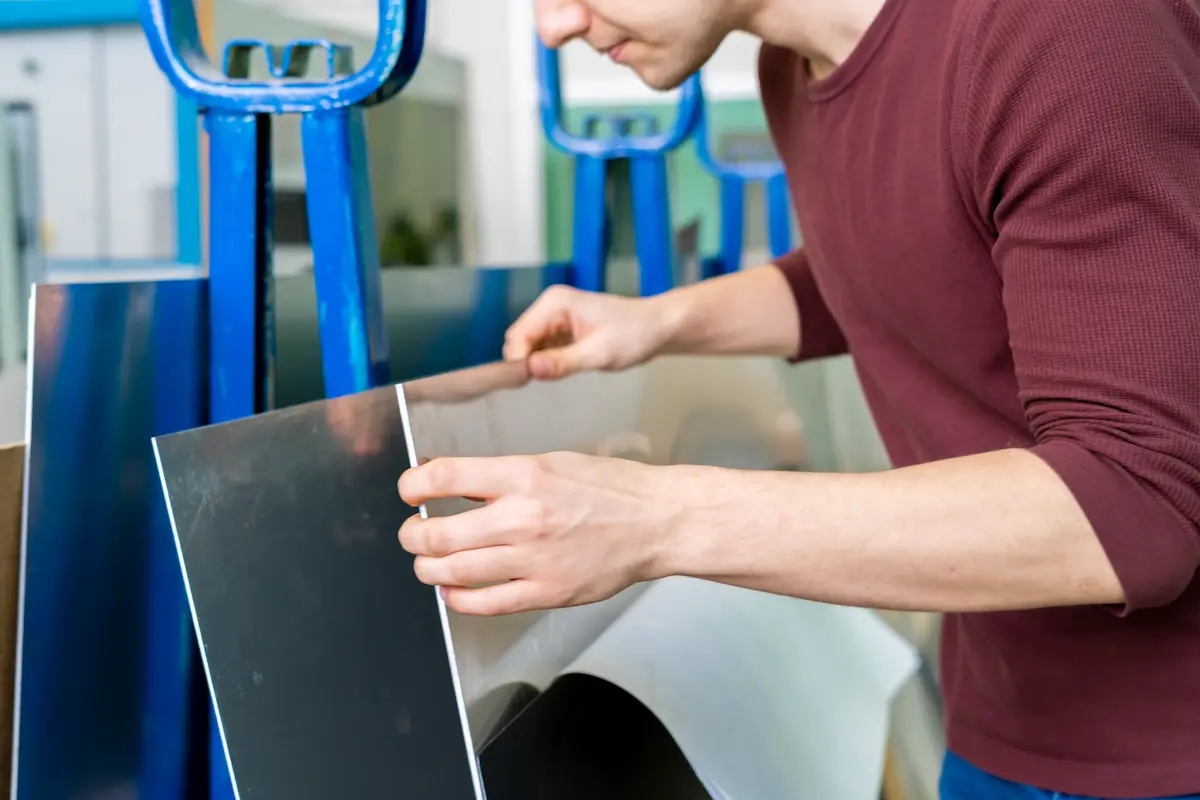
Custom sheet metal for industrial machining and technical assemblies
Those who request custom sheet metal are mainly looking for two certainties: that the component will meet dimensions even after bending and that it will not be deformed during welding of the thin sheet metal. This is where FGM’s work steps in, because custom sheet metal is produced by integrating
Why custom sheet metal should be designed with welding in mind
In thin sheet metal, heat applied during casting generates immediate changes: shrinkage, bending, loss of bend angle or opening of flaps. Therefore, dimensional customization cannot be considered an isolated operation.
A custom sheet must be born with a geometry prepared to withstand the heat cycle, otherwise welding will require rework that will negate the precision achieved in the previous steps. Preliminary design evaluates thickness, expected fusion area, constraint points, and structural continuity after cutting and bending so as to determine how the part will react to the weld bead.
How laser cutting affects sheet metal behavior during welding
Laser cutting not only defines dimensions: it determines how the sheet metal will absorb heat in subsequent steps. An edge with constant roughness reduces local energy concentration, while too large a thermal marking can displace the thermally affected zone.
Therefore, in custom productions, the choice of power parameter and cutting speed is also calibrated according to the type of weld expected. In thin panels, an over-extended HAZ already after cutting can make the structure more unstable during casting; in contrast, a clean cut reduces the need for edge preparation and improves joint stability.
| Cutting parameter | Effect on welding |
|---|---|
| Excessive power | Wider HAZ, less stability in thin zones |
| High speed | Clean edge, less uneven heat absorption |
| Incorrect focus | Possible difference in fusion between neighboring areas |
How bending affects welding and why consistency between the two steps is needed
After cutting, the bend is the step that most affects the reaction of the sheet metal during welding. A crease creates a buildup of internal stresses: if the bead will be run close to the line of curvature, the heat will release these stresses causing corner opening or localized shrinkage. For this reason, custom-made sheets are designed by considering where the bead will pass, what the direction of shrinkage will be, and how to stabilize the part through supports or bracing. In three-dimensional parts, the sequence of folds is equally relevant: a geometry stiffened too early prevents natural compensation of movements during casting.
- Folded corners that serve as the base of the joint;
- zones with different stiffnesses that react asymmetrically to heat;
- edges away from the fold that accumulate lower stresses and are more stable;
- Components with multiple folds that require controlled sequence of welding.
Thin sheet metal welding and strain management
Thin sheet metal is sensitive to any thermal variation. To stabilize it, the choice of process depends on how critical the post-weld behavior is. GTAW offers very fine arc control and allows low input, which is useful when alignment or aesthetics must be preserved. MIG requires precise parameterization to avoid excessive heat, but allows continuity in repetitive batches. The decision depends on the geometry, the actual thickness after bending, and the structural role the part will play in the final assembly.
| Technical appearance | MIG | TIG |
|---|---|---|
| Heat input | Medium, requires stable parameters | Low, high control |
| Expected deformation | More sensitive on small thicknesses | Smaller, suitable for critical parts |
| Speed | High in serial batches | Average |
Why the process must be integrated to ensure dimensional consistency
Sheet metal behavior is never random: it is the sum of the reactions that the material accumulates from cutting to welding. If each stage is designed separately, the final geometry will depend more on the deformations than on the technical drawing.
For this, the tailor-made process must be integrated. Laser cutting, bending, and welding are set up to compensate for each other’s limitations. For example, a bend that stiffens the part too much before welding can be brought forward or shifted; similarly, the bead sequence can be designed to take advantage of the natural bending of the sheet rather than counteract it.
Coordination between design and production to avoid rework
A custom sheet metal sheet only really works when design and production dialogue from the beginning, because each step changes the behavior of the part in subsequent ones. The placement of joints, the distance from folds, and the orientation of cuts affect the material’s ability to absorb heat without losing linearity.
The choice of bending direction and sequence also changes the distribution of internal stresses, which are quickly released during casting. Therefore, the design takes into account not only the shape, but
A well-coordinated flow then allows the process from drawing to finished component with a minimal amount of correction, turning a potentially unstable process into a controlled sequence.
Customized sheet metal designed to behave properly in production
When it comes to custom sheet metal destined for an industrial cycle, starting geometric precision is not enough: the material must maintain its shape even as it undergoes thermal changes, internal stresses and settling movements during welding. In bent components or those with multiple close joints, the sheet metal reacts with behaviors that may seem random, but are the direct result of the previous steps. Effective design anticipates these effects by defining appropriate thicknesses, flap lengths, dissipation spaces, and constraint points that allow the part to absorb and release heat without compromising functional dimensions. This approach results in parts that do not require subsequent straightening, adjustment, or filing, reducing the risks involved in any rework, especially on thin stainless or steels with high heat sensitivity.
Thus, custom sheet metal works when it is treated as an interconnected technical organism: cutting defines the edge, bending creates the structure, and welding stabilizes or stiffens critical areas. If these steps are designed together, the part goes through the production cycle with predictable behavior, maintaining required alignments and reducing deviations from design. This means less production dispersion, faster assembly times, and the ability to fit components into complex systems without the need for improvised adaptations. In an industrial context, this predictability is what distinguishes a simple cut sheet from a true custom sheet designed to work correctly at every stage of the process.