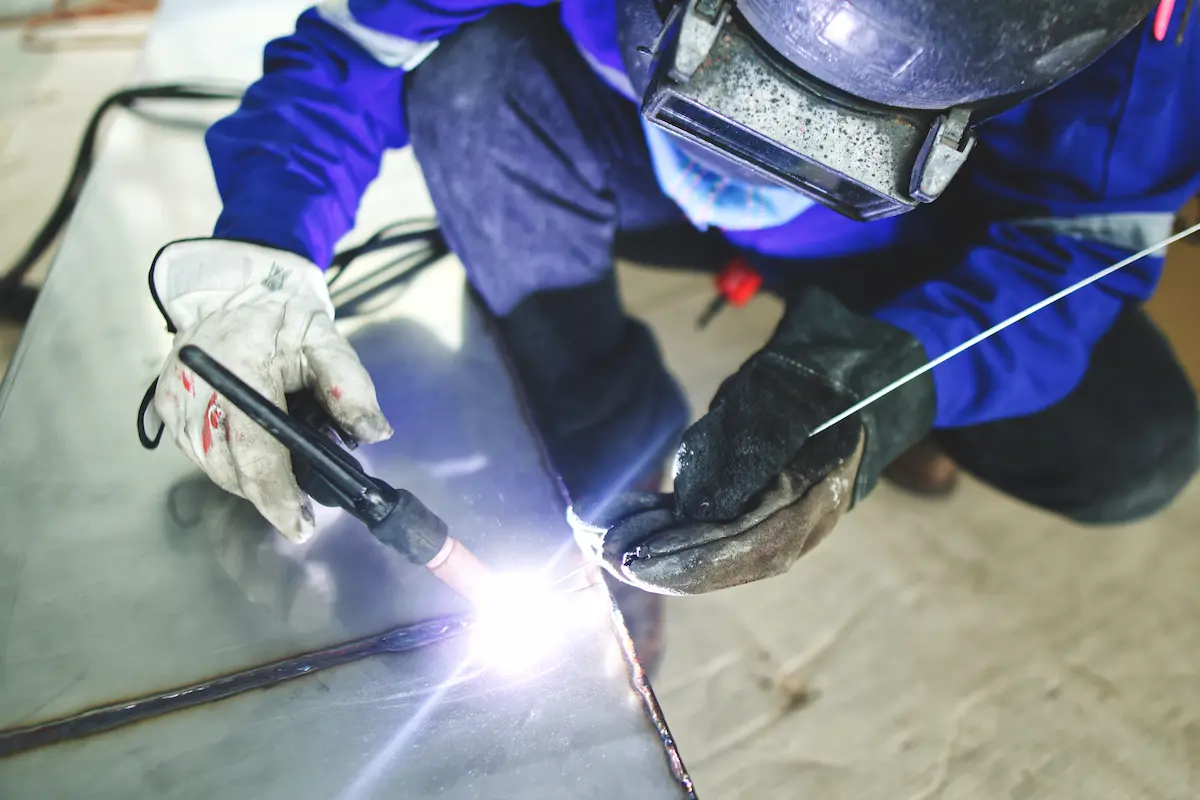
MIG TIG sheet metal welding for precision machining
MIG TIG sheet metal welding for integrated precision machining
Sheet metal welding requires technical management capable of maintaining stable geometries even after cycles consisting of laser cutting, CNC bending, and subsequent assembly. In contract manufacturing, the quality of the joint depends not only on the welding process but on the ability to control
The role of welding in the sheet metal production cycle
Each process on the sheet metal generates effects that continue into subsequent stages, and welding is the one that is most likely to amplify any micro-shifts.
A close-tolerance bend can accentuate the tendency to warp during fusion, just as a thin panel can react with localized shrinkage that compromises flatness. The interaction between heat and material thus takes on design value, because the weld must adapt to the behavior of the sheet metal, not the other way around.
It is therefore important to maintain consistency with the finishing and precision carpentry stages to ensure continuity between technical drawing and final component.
MIG and TIG in sheet metal real operational differences
MIG and TIG technologies should not be considered as generic alternatives but as tools with specific potentials and limitations when working with sheet metal.
The MIG process maintains a constant speed and smooth deposition, which is useful in repetitive batches with medium thicknesses.
TIG, on the other hand, prioritizes control of heat input and allows operation on stainless steel or reduced thicknesses, reducing strain sensitivity.
On the shop floor, the choice between the two processes is based on how the sheet metal will behave after casting, the aesthetic quality required, and the role of welding within the structure.
Evaluation of the MIG process in sheet metal fabrications
MIG is suitable when sheet metal needs to maintain a level of mechanical repeatability even with large production runs. The stability of continuous wire makes it possible to handle linear joints well, but it requires special attention to sequencing, because heat concentration can generate asymmetrical draft.
In components from punching or multiple folds, it is useful to set short, alternating beads, reducing cumulative strain and preserving the angle of the folds. MIG also performs well in structures that require strength rather than aesthetics, especially when the bead will later be masked by assembly.
Evaluation of the TIG process in thin sheet metal and stainless steel
TIG allows the arc to be modulated with greater precision and thus reduce the volume of the thermally affected zone. This becomes crucial in thin sheet metal, where even slight excesses of feed can generate visible deformation. In stainless steel, it is useful to control the feed rate to avoid unwanted discoloration and preserve surface appearance. GTAW also makes it possible to follow geometries very close to critical bends without compromising alignment, limiting the need for subsequent grinding when the component will transition to satin-finishing or other surface finishes.
MIG TIG technical comparison on sheet metal
| Appearance | MIG | TIG |
|---|---|---|
| Contribution | Increased, useful in medium thicknesses | Reduced, suitable for fine sheet metal |
| Deformation | Containable with alternating beads | Less due to thermal control |
| Aesthetics | Adequate for structural | High for stainless and exposed surfaces |
| Productivity | High in repetitive batches | Medium but accurate |
Robotization of welding in sheet metal
Robotization makes it possible to maintain bead stability that is difficult to achieve manually when geometries are derived from laser cutting and multiple folds. Path control systems reduce sensitivity to micro-tolerances and allow minimal variations to be compensated for by sensors or probing.
In repetitive components, robot programming avoids differences between batches and reduces the volume of rework. This approach is particularly useful in parts that must maintain rigid alignment with other structure elements or that serve as the basis for subsequent assemblies.
Precision welding on stainless steel in sheet metal working
Stainless steel requires very careful heat management because its conductivity generates rapid effects that are difficult to control. The combination of low heat input and adequate gas protection allows for a smooth bead without changing the behavior of the bent sheet.
In components intended for technical areas, it is useful to avoid thermal concentration near areas that must maintain tight tolerances, because even minimal shrinkage can alter the position of references.
In serial productions, the stability of GTAW allows consistent quality to be maintained even when surfaces will undergo finishing.
Operating guide for sheet metal welding
The execution of welding requires a series of preliminary checks that reduce the risk of deformation and ensure consistency between the different processing steps. The choice of process must start with the thickness and residual stiffness of the component, assessing whether the energy required for fusion may compromise the angle or flatness. The sequence of the beads affects the behavior of the sheet metal, and alternating the melting points allows for heat distribution. The choice of fasteners also plays a strategic role, because clamping the part excessively can transfer stresses that are released during cooling, generating unexpected deformations.
| Factor | Indication |
|---|---|
| Stiffness | Assess weak areas after folding and cutting |
| Sequence | Alternate cords to distribute heat |
| Fastenings | Avoid overly rigid fastenings that create tension |
| Material | Adapt parameters to stainless, steel and fine sheet metal |
Integrated welding in sheet metal production
Welding effectiveness increases when it is designed as part of a single production path, not as an isolated operation. Coordinated handling of laser cutting, bending, welding and finishing reduces the likelihood of accumulating dimensional errors and improves the final quality of the component. Welding thus becomes a stabilizing tool and not a step to be corrected later. When each step is harmonized, the aesthetic and structural performance of the part also reflects the consistency of the entire process.