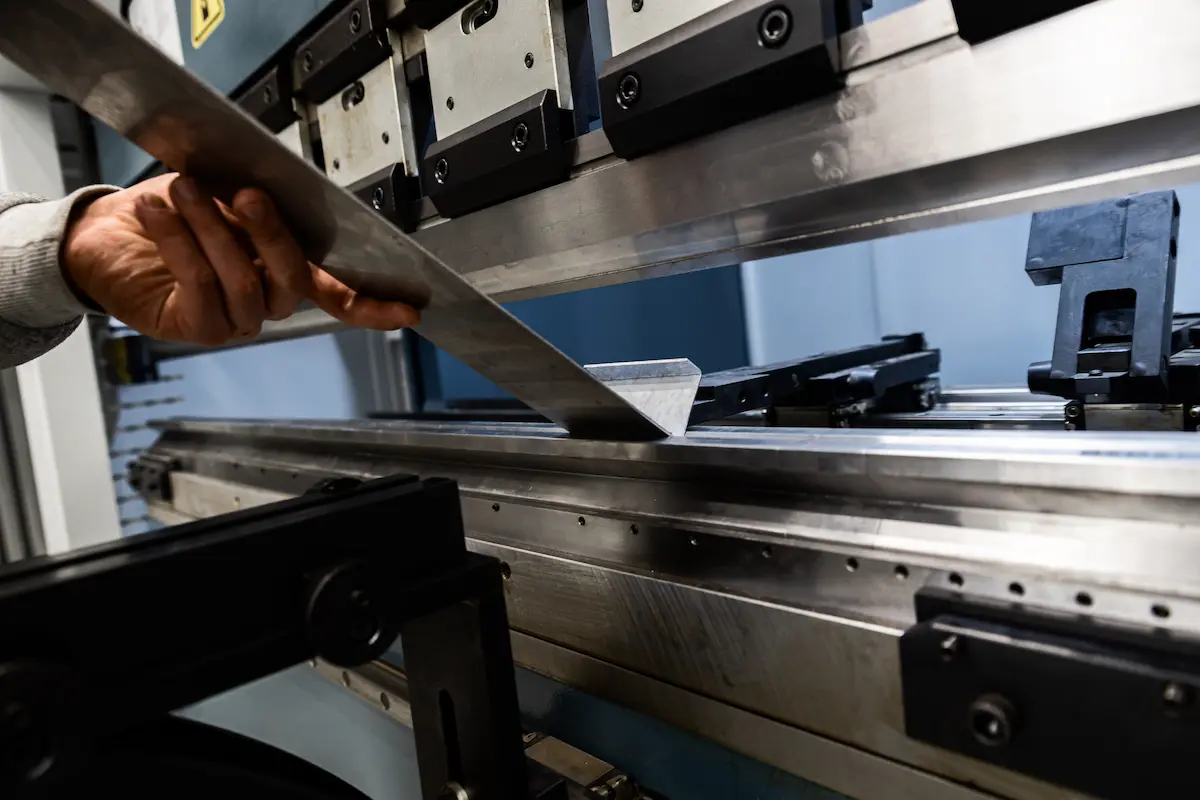
Hydraulic sheet metal bending and alternative technologies in industrial production
Sheet metal bending by hydraulic press is now one of the most reliable solutions for obtaining high-precision components on consistent thicknesses and long lengths. In manufacturing, this technology can handle variations in size, complex geometries and different materials without compromising dimensional stability, becoming a critical node for those working in precision carpentry or the fabrication of complex metal structures.
When hydraulic bending is the right choice for sheet metal
Hydraulic bending is selected when the process requires a combination of available force, deformation control and repeatability of the bend radius. The pressure generated by the hydraulic circuit makes it possible to process large thicknesses while keeping the punch trajectory consistent and ensuring a constant angle along the entire length of the part. This is especially useful for structural profiles, large paneling or components requiring high-precision fits.
Unlike purely mechanical solutions, pressure regulation enables better management of material springback, reducing the need for manual corrections. The result is greater production continuity and more uniform quality even on variable batches. For companies working with high-strength steels or special alloys, this adaptability becomes a determining factor.
An additional advantage is the ability to integrate advanced control systems that monitor the position of the punch and automatically adjust the depth of penetration. This type of dynamic management reduces deviations and allows the set angle to be maintained even with materials with less than perfectly uniform thickness tolerances.
Hydraulic press brake operation
At the heart of the hydraulic bending machine is a circuit that generates the pressure needed to move the moving crosshead. During the work phase, the pressure is transferred to the punch, which exerts a controlled force on the sheet metal resting on the die. The precision of the movement depends on elements such as the rigidity of the structure, the quality of the control valves and the speed of the system in compensating for any variations.
Bending angle is managed through control of punch sinking, which can be programmed with high accuracy. Dedicated sensors monitor position in real time, allowing consistent bending throughout the part. A bending machine with advanced control reduces the risk of differences between the first and last piece in the batch, keeping the bend consistent even on materials that tend to stiffen with deformation.
Main advantages of hydraulic folding
The advantages of this technology are especially apparent when a combination of high force and operational consistency is required. The hydraulic bending machine ensures excellent
Operational flexibility also makes it possible to handle small and medium series without the need for complex tooling. A single machine can cover different geometries, reducing set-up times and ensuring continuity in production. For industries that require frequent prototypes and variations, this is a significant advantage in work planning.
Limits and conditions to be assessed
Despite its versatility, hydraulic bending has some production-related issues to consider. Energy absorption is higher than other technologies, and cycle time may be less rapid when machining simple geometries or thin thicknesses. Tool material wear is also a factor to monitor, as it affects angle retention and edge quality.
Hydraulic bending also requires careful calibration when working with materials with low springback or minimal thicknesses: excessive pressure can generate unwanted marks or deformations. For this reason, operator experience and the quality of digital controls become key elements in ensuring stable production.
| Parameter | Positive effects | Criticality or attention |
|---|---|---|
| Hydraulic pressure | Effective springback management and improved angle stability | Incorrect pressure can generate marking or deformation |
| Structural rigidity of the machine | Uniform force distribution along the length of the bend | Possible angle differences on machines that are not perfectly aligned |
| Digital control of sinking | Enhanced repeatability and automatic correction of thickness variations | Requires periodic calibration and reliable sensors |
| Tool quality | Reduced edge inaccuracies and increased tool life | Accelerated wear with high-strength steels or intensive batches |
| Thermal management of materials | Higher quality of bending on ductile or treated materials | Very stiff materials require high compensations and forces |
The choice of roller folding and when it pays to use it
Roller bending is considered when the goal is not to obtain a defined angle, but a progressive curvature or circular shape. Unlike hydraulic bending, which concentrates the force at one point, roller bending distributes the stress over a greater length, allowing for large, continuous radii without obvious scoring.
This technology is particularly suitable for producing open tubulars, ventilation shrouds, metal furniture elements or components for industrial plants. Working in multiple passes, the machine allows gradual control of bending, with a good level of precision even on medium-thickness sheets. In addition, the fact that the sheet metal runs between adjustable rollers makes it possible to handle differentiated radii along the part, expanding the range of design possibilities.
Principle of roller bending
The process relies on three or more rollers, the positioning of which determines the degree of curvature. The center roller exerts adjustable pressure that changes the trajectory of the sheet as it flows. Deformation occurs in a gradual and controlled manner, avoiding stress concentrations typical of punch bending. The final quality of the bending depends on the stiffness of the rolls, their surface finish, and the correct setting of the axle spacing.
Areas of application
Roller bending is also chosen when it is necessary to maintain a high level of part aesthetics, without marking or crushing. Industries such as metal furniture, machinery casing construction, and medium-heavy carpentry employ this technology to achieve shapes that traditional bending cannot generate as smoothly.
Key parameters influencing the result
The most important parameters include the pressure applied by the center roller, the speed at which the workpiece is fed, and the quality of the material. Machine symmetry is also a relevant factor: misalignment of the rollers can generate deviations in radius or variations in curvature between one end and the other. To achieve consistent quality, it is essential to carefully adjust the sequence of passes, increasing the curvature evenly.
The manual sheet metal bending machine and the contexts in which it remains a viable choice
Despite the spread of increasingly automated technologies, the manual bending machine retains a definite role in sheet metal processing, especially when production involves small batches, prototypes or set-up work. The simplicity of construction allows rapid operations to be handled without significant set-up time, proving useful in craft settings or in the preliminary stages of component development.
For machining operations that do not require high force or very tight radii, the manual bending machine can provide good accuracy, especially if equipped with reliable mechanical references. The lack of pressurization systems, typical of hydraulic solutions, means more operator effort but also reduces maintenance complexity and energy consumption.
When a manual solution is really appropriate
A manual bending machine becomes appropriate when the material has low thicknesses and the geometry of the bend is not particularly critical. It is particularly useful for making adjustments, making small profiles or handling individual parts while maintaining good edge control without requiring the structural rigidity of a hydraulic machine.
In the industrial context, these machines can be used as a support to the main lines, for example, for finishing tasks or for special products that do not justify the use of a more powerful bending machine. In some carpentries, the manual solution is an operational complement that allows separation of processing flows and prevents congestion on automatic lines.
Minimum technical parameters to be considered
Despite their simplicity, manual bending machines require attention when evaluating elements such as frame rigidity, hinge quality, and table stability. An inadequately strong frame can generate variations in bending angle or micro-bending, especially when working with semi-hard materials.
The useful width of the machine is another parameter to consider: a model that is too short drastically limits operational possibilities, while one that is too long can be inaccurate if not equipped with adequate reinforcements. Finally, the accuracy of mechanical feedback directly affects the repeatability of the bend, making the process more or less reliable depending on production requirements.
Profitability and limitations of manual bending on an industrial scale
In B2B, manual bending finds a well-defined role only when volumes are low or when the company needs to maintain high operational flexibility. However, the cycle time is inevitably longer than with a hydraulic press or roller bender, which affects overall productivity. In addition, the processing outcome is highly operator-dependent, with greater variability than with automated processes.
Despite these limitations, the manual bender proves to be a useful tool in prototyping, maintenance departments, and industrial settings where last-minute changes require quick action without interrupting the main production cycle.
| Appraised aspect | Strengths | Limitations or cautions |
|---|---|---|
| Structure and stiffness | Good responsiveness on thin thicknesses, direct operator control | Possible microflexing on semi-hard sheets or long formats |
| Executable geometries | Simple bends, adjustments, small profiles | Not suitable for very tight radii or particularly critical angles |
| Cycle time | Fast on single parts and spot machining | Slow on medium to large batches and uncompetitive on serial production |
| Repeatability | Acceptable with well-calibrated mechanical reference marks | High variability depending on operator and reference wear |
| Cost and maintenance | Low initial investment, minimal maintenance | Limited process growth capacity and low automation |
How to choose the right folding technology and evaluate the supplier
The selection of the most suitable bending technology depends on a combination of technical and production factors. A B2B decision maker must evaluate aspects such as
A qualified supplier should be able to ensure production continuity with a diverse fleet of machines, capable of combining hydraulic bending, roller bending and manual solutions when needed. This makes it possible to deal with processes ranging from precise shaping to wide radii to small support folds, while maintaining consistent quality of the result.
In the evaluation process, the ability to integrate bending with other sheet metal processes, such as laser cutting or finishing, also become relevant. A well-synchronized cycle improves the alignment of dimensions and ensures that each operation occurs on a stable geometric basis, reducing the risk of rework along the production chain.