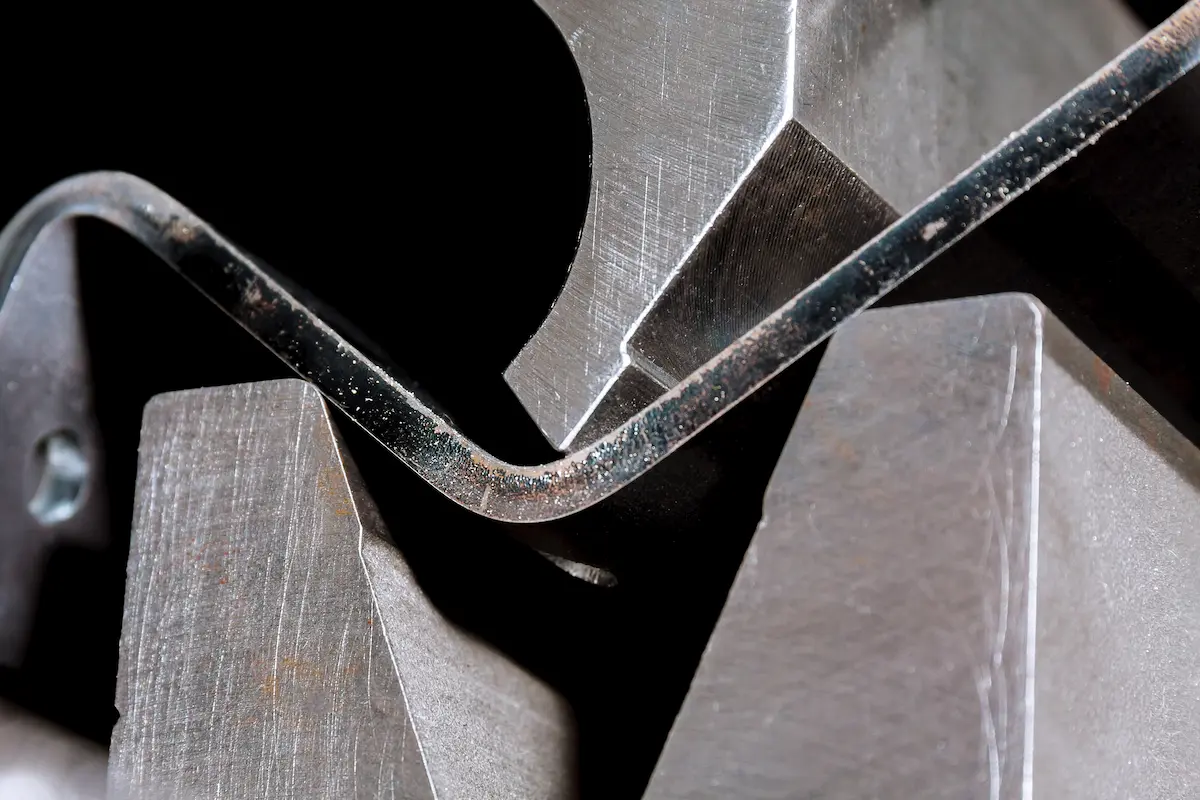
Sheet metal bending techniques and operating principles for stable production
Sheet metal bending is a phase where many of the technical choices that determine the quality of the finished component and the continuity of the production cycle are concentrated, especially when working in series on different materials and varying thicknesses. The techniques available, from the simplest V-bends to the most complex Z- or N-bend configurations, require an accurate balance between geometry, machine parameters and material properties, so that each section of sheet metal accompanied in deformation remains under control throughout the entire supply chain.
| Folding technique | Operational description | Advantages | Criticality | Typical applications |
|---|---|---|---|---|
| V-bend | The punch sinks into the V-shaped die by modulating the deformation and final angle. | High flexibility, good angle repeatability, wide tooling range. | Sensitive to springback; requires frequent checks on different materials. | General profiles, panels, lightweight structural elements. |
| U-bend | Sheet metal is formed with two parallel walls and a base, requiring dedicated tools. | Excellent wall stability and good housing definition. | Requires adequate breakaway spaces and strict controls on wing spacing. | Boxes, bins, technical frames. |
| Z-fold. | Allows you to create a height difference with two opposite corners and a shifted center section. | Good control of dimensions between levels; ideal for connections. | Requires minimum correct distances between fold lines. | Brackets, supports, functional joints. |
| N-fold. | Makes a three-fold sequence for articulated, multilevel geometries. | Versatile for complex components and large dimension changes. | Increased sensitivity to cumulative tolerances. | Reinforced supports, structural connections. |
| Air bending | Punch does not reach die bottom, modulating angle by sinking depth. | Wide flexibility with one tool; reduced stress. | More obvious springback and greater material dependence. | Variable batches, prototyping, components with varying angles. |
| Bottom bending | The punch brings the sheet metal almost into full contact with the die. | Very stable angle and minimal variability between parts. | Higher stress and less adaptability to different materials. | High precision components or critical mechanical functionality. |
| Bending with a die | The punch “stamps” the angle by constraining the plate in the die. | Almost total reduction of springback. | Requires specific tooling and high force. | Critical productions and high-precision sectors. |
Overview of bending techniques applied to sheet metal
When we talk about sheet metal bending, we are not referring to a single method, but to a family of techniques that achieve different results with the same material and thickness. The choice of one configuration over another depends on the profile to be made, the radius required, the number of bends, and the interaction with preceding and subsequent steps, such as laser cutting of the sheets or finishing operations that define the final surface.
Characteristics of V-folding and when it is preferred
V-bending is the most widely used solution in most industrial settings because it allows a wide range of angles to be achieved with a relatively small tool set. The punch pushes the sheet metal into a V-shaped die, and sinking control allows the resulting angle to be modulated. This method is suitable for both medium batches and repetitive production, as angle repeatability remains high when the machine is properly calibrated and tooling quality is kept consistent over time.
In the presence of preliminary machining, such as panel punching, the V-bend offers good compatibility with holes and slots close to the fold line, provided minimum clearances and adequate radii are observed. The ability to handle springback through small adjustments on sinking makes this technique particularly attractive for those machining different materials within the same production flow.
Situations in which U-bending on medium-thickness sheet metal is useful
U-bending is chosen when the component requires a box profile, with two parallel walls separated by a relatively narrow base. In these cases, the tool geometry must provide sufficient run-out space for the material, avoiding interference between the punch flank and already bent walls. Controllability of the wing gap becomes a critical parameter, because it affects subsequent assembly operations and the ability of the part to accommodate internal elements, reinforcements or electronic components.
With medium-thickness sheets, U-bending requires careful evaluation of the internal radius and material shrinkage to prevent the base from being deformed or the walls from remaining parallel. The use of dedicated dies, combined with angle control systems, makes it possible to reduce deviations and correct any differences between the first pieces and subsequent batches, keeping production aligned with design specifications.
Applications of Z- or N-bends in complex components
Z- or N-shaped configurations make it possible to create height displacements on flat elements, often used to connect surfaces at different levels or to make brackets and supports with articulated profiles. In these situations, the succession of bends must be planned so that any deformation does not interfere with the bends already made, preserving linearity and parallelism of the surfaces that serve as reference for assembly.
The distance between the bend lines, the inner radius, and the die punch coupling directly affect the final size of the component. A slight variation in these parameters can result in assembly difficulties or the need for rework. For this reason, Z- or N-bends are often combined with real-time angle control systems, which allow springback compensation depending on the material and rolling direction.
Conditions that lead to choosing advanced techniques such as cone fold or precision folding
When the required tolerances are particularly tight or the part has sensitive mechanical features, it may be necessary to use techniques such as bottom bending or taper bending. In these cases the punch brings the sheet metal into almost complete contact with the die, reducing angle variability at the expense of increased material and tool stress. Angle stability becomes the main criterion, while springback is almost eliminated due to more intense deformation in the bending zone.
Adoption of these techniques requires careful evaluation of material strength and tool life, as well as careful control of lubrication and cleaning conditions. They are often chosen for components that will be subjected to dynamic loads, or in contexts where bending is a critical reference for subsequent sheet metal welding or mating with machined parts.
Sheet metal bending manual for industrial settings
Turning bending techniques into a repeatable process requires consideration of the relationship between material characteristics, required geometry, and machine performance. An effective operations manual does not simply list calculation formulas, but relates minimum radius, springback, rolling direction, and tool selection so that each bend is the result of an informed decision and not a sequence of trial and error.
Material management between minimum radius, thickness and springback
Each material has its own bending behavior, defined by parameters such as yield strength, elongation and elastic modulus. The inner radius cannot be chosen arbitrarily, because too tight a radius relative to thickness leads to stress concentrations and risk of micro-cracking on the outer fiber.
At the same time, an excessively large radius can change the overall dimensions of the component and create problems during assembly.
Springback, i.e., the tendency of the material to “reopen” after the load is removed, requires controlled overbending to be calibrated according to alloy, thickness, and tool configuration. By managing these parameters systematically, manual corrections can be reduced and quality can be kept stable over different batches, even when the sheet metal comes from different castings or supplies.
Choice of orientation versus lamination and implications for sealing
The direction of rolling affects the way the sheet metal deforms, because the fiber of the material tends to follow the original direction of processing. Bending crosswise from the rolling direction can increase the risk of cracking or tearing at the outer edge, especially with high-strength materials. Proper drawing setup takes these issues into account by defining fold orientation and distance from previously processed areas, such as cuts or holes obtained with automated sheet metal processing systems.
During product industrialization, the choice of orientation is often shared between the engineering department and production, in order to balance requirements for strength, aesthetics, and compatibility with available formats. Conscious management of the rolling direction reduces the dispersion of results and improves the predictability of bending behavior throughout the life of the component.
Role of tools in curve stability and edge quality
Proper tools not only serve to achieve the correct angle, but also contribute decisively to edge quality and bend stability. The choice of tool material, surface finish and die opening determines the distribution of stresses during bending.
A die that is too narrow relative to the thickness can mark the plate or generate bulges, while an excessively wide die requires greater forces and makes angle control more difficult.
Scheduled tool maintenance, with checks on radius wear and linearity of contact surfaces, is essential to avoid progressively increasing drifts in part quality. In high-productivity settings, structured management of punch and die libraries, integrated with CAD CAM systems, allows each geometry to be consistently associated with the most suitable combination, reducing the margin of operational error.
Machine control with parameters to be checked before production
Before starting production, a number of machine parameters that directly affect process stability should be checked. These include the correct calibration of the back references, the linearity of the crosshead, the accuracy of the position sensors, and the correspondence between set values and measured angles in the test parts. Preventive control reduces initial rejects and allows a working window to be set in which variability remains within acceptable limits for the customer.
With a view to integrating bending into the supply chain, consistency between design data and the parameters actually used on the machine facilitates dialogue with other stages, such as sheet metal finishing operations or assembly activities. Systematically recording the combinations of parameters that lead to the best results also makes it possible to build a real internal bending manual over time, adapted to the specific materials and production requirements.
Sheet metal bending rules that ensure quality and consistency
Effective bending is not only a matter of technique, but also of systematically adhering to certain rules of operation that control deformation and reduce the risk of defects throughout the production cycle. The goal is to maintain consistency between parts, avoid unanticipated variations, and ensure that each bend integrates smoothly with the work performed before or after, including metal component welding or assembly activities.
Set of rules to avoid defects such as cracks, markings, or twisting
Defects in bending can originate from a combination of incorrect parameters, inadequate tooling, or improperly calibrated machine settings. Cracks and microcracks often occur when the inner radius is too small compared to the thickness or when the rolling direction is not considered in the design. Markings, on the other hand, result from excessive pressure or tooling surfaces that are no longer uniform, concentrating force in circumscribed spots.
Another recurring defect is part twisting, typical of bends on sheets with long lengths or uneven material distribution. In these cases, proper management of positioning on the machine and the use of lateral supports reduce deformation, keeping the geometry within the limits required by the design. By applying clear rules during part preparation, the incidence of these defects can be reduced even on demanding production volumes.
Parameters to be met to keep the angle constant throughout the geometry
Angle constancy along the fold is one of the most frequent challenges in mass production. Small differences in thickness, tool wear, thermal variations or irregularities in material flatness can generate even significant variations. Therefore, it is critical to regularly check the depth of punch sinking, verify the residual elasticity of the material, and adjust any deviations in real time using integrated sensors or angle controls.
The straightness of the die and crosspiece directly affects the accuracy of the result. A misaligned machine can produce differences between the center and end of the part, especially with long panellings. Periodic checking of the support points, combined with scheduled maintenance of the contact surfaces, can keep the bend stable and reduce the margin of error in production.
Relationship between folding and previous processes such as cutting and punching
The quality of the fold also depends on the accuracy of the processes performed beforehand. A less-than-perfectly straight cut or punching with local deformations interferes with the stability of the edge and the ability of the sheet to rest properly on the die. This is why productions integrating technologies such as automatic laser cutting or numerically controlled punching ensure a more consistent and predictable basis for the bending stage.
Hole distances from fold lines also affect the strength of the outer fiber. Careful design places holes, slots or fillets in safe areas, respecting minimum distances related to thickness and material. This relationship between geometry and fold should be considered early in the component development process so as to avoid costly rework or late changes to toolpaths.
Tables and technical criteria for choosing the most suitable technique
| Folding technique | Key advantages | Limitations and cautions | Ideal contexts |
|---|---|---|---|
| V-bend | Flexibility, good angle control, wide tool compatibility | Requires frequent calibrations on materials with strong springback | Medium batches, components with variable angles, structural profiles |
| U-bend | Parallel wall stability, good base control | Requires large escape spaces and dedicated tooling | Box profiles, housings and technical frames |
| Z-fold or N-fold | Creation of multiple layers with controlled displacements | Increased sensitivity to distances between fold lines | Brackets, supports, functional connections |
| Bending with taper | Extremely stable angle and reduced springback | Increased material and tool stress | High-precision components with critical mechanical functions |
Decisive factors depending on production volume and material type
Selection of the most appropriate technique must consider not only the geometry of the part, but also the production volume required and the nature of the material. Materials with pronounced elastic behavior require greater angular compensation and a more precise combination of punch and die, while high-volume productions benefit from highly repeatable techniques and more robust tools.
A preventive analysis of the component lifecycle makes it possible to identify any critical issues, such as accelerated tool wear or radius changes in later stages. In B2B contexts, the ability to predict these interactions makes it possible to reduce downtime, improve planning, and maintain consistent product quality throughout the supply chain.
Impact of folding choices on the quality of downstream operations
The choice of bending technique directly affects the assembly and welding stages. An angle that is not perfectly constant can generate misalignment or excessive clearance in the couplings, while too large a radius can change the functional dimensions of a housing. Establishing already at the design stage which bend will be adopted allows parameters to be synchronized between the various processes, including the material selected and the finishing technique that will close the production cycle.
Sheet metal bending as an element of efficiency along the metal supply chain
The evolution of bending techniques is leading companies to integrate intelligent control systems, dedicated automation and digital tools that improve process predictability. The goal is not just to perform a correct bend, but to make the entire production sequence more stable, reducing scrap and facilitating the management of variable batches without compromising quality.
Evolved sensors, real-time feedback, and digitized tool libraries reduce setup times and minimize drifts typical of traditional manufacturing. A more predictable bend results in easier assembly, cleaner welds and less need for corrections in the finishing stages. This systemic approach reinforces consistency between design, production, and quality control, fostering greater efficiency throughout the metal supply chain.
Do you need a reliable partner? Contact us!