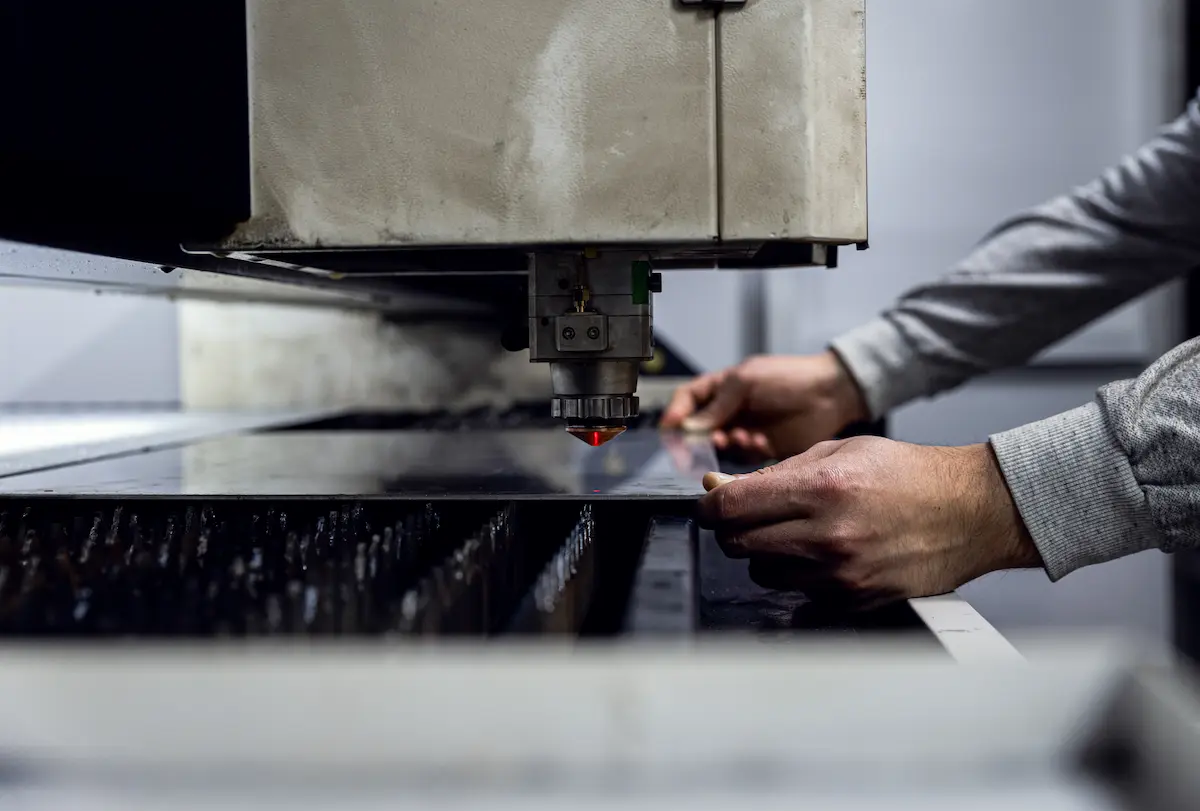
Iron sheet metal cutting for professional applications
Cutting sheet iron consistently with production requirements is important in order to set up a process capable of ensuring accuracy, repeatability, and edges ready for further processing. The choice does not come down to the tool, because each technology affects the dimensional stability, cycle time and quality of parts destined for bending, welding or structural assembly. This is why cutting represents a real stage of industrialization, where the initial assessment of material and geometry conditions the entire production flow.
Parameters that determine the quality of iron sheet metal cutting
When working with iron and structural steels, material response varies depending on variables that directly affect edge stability. Metallurgical composition, thickness and rolling direction determine how the material absorbs mechanical or thermal energy. Thin sheets require precise deformation controls, while medium-thick sheets develop thermally altered zones that must be anticipated if the part will later be bent or welded.
Geometry also plays a key role. Large pieces amplify vibration and displacement, while narrow or highly articulated shapes require a process capable of producing consistent curves and repeatable angles. The initial analysis defines which technology achieves an edge that remains stable after bending, maintains uniform angles, and reduces finishing steps.
Each process must be evaluated considering the interaction with bending, welding, and finishing. A non-perpendicular cut leads to repeated adjustments in bending, while an excessive thermal zone can make welding less predictable or shift the alignment of flanges and couplings. When the cut is set correctly, it becomes the basis for stable production and faster flow, reducing scrap and rework.
Professional technologies for iron sheet metal cutting
Currently available technologies cover the full spectrum of carpentry needs, from high-volume linear production to complex shapes intended for mixed cycles. Each process differs in applied energy, type of separation and edge quality. Understanding the implications allows you to choose the solution that is truly consistent with the work volume, material and subsequent deformation.
Panel shearing and repeated linear cuts
Shearing is an efficient choice when cutting must be perfectly straight and repeated on medium or high batches. Cutting is done without introducing heat, so the structure of the iron remains unchanged. This results in edges that maintain perpendicularity and facilitate bending or welding steps, especially when tolerances are tight.
It is particularly suitable for panels, coats and semi-finished products intended for carpentry work where productivity and consistency are priorities. The main limitation is geometry: if the part requires articulated shapes or drilling, a more flexible technology is needed.
Punching for repetitive drilling and integrated micro-deformation
Punching processes sheet metal by mechanical removal, allowing not only cuts but also small deformations such as reliefs, slots, extrusions and functional impressions. This makes it advantageous when the part must integrate repeated geometric elements without going through additional steps.
The process is ideal for components with numerous holes or repetitive paths. Combined configurations make it possible to combine the speed of punching with the flexibility of laser, handling complex contours and reducing the number of manipulations. Punching thus becomes an efficient solution when high productivity and the ability to add functionality during cutting are needed.
Laser cutting for precision and geometric consistency
Fiber laser cutting has introduced a new level of accuracy to iron sheet metal work. The ability to maintain a
The main advantage emerges when the part is to be automatically bent or welded. The laser-obtained edge maintains a quality that reduces adjustments and intermediate checks. For sheets intended for aesthetic fits or applications requiring high dimensional stability, laser emerges as the most consistent technology. Those needing more technical information can learn more about laser cutting and its applications on iron sheets.
Plasma and oxyfuel for high thicknesses
When thickness increases and steel requires significant energy to separate, plasma and oxicutting become the most advantageous technologies. Plasma offers speed and the ability to follow articulated shapes even on thick laminates, while oxicutting allows very strong materials to be cut with low operating costs.
The introduction of thermal energy requires careful management of the altered zone, especially when edges will become part of welded joints. Both technologies generate burrs and oxides that need to be removed, but the ability to handle large thicknesses remains a decisive advantage for carpentries geared toward strong structures.
Technical criteria for choosing the most efficient cutting process
The choice of process is not based on the most powerful tool, but on the balance between thickness, geometry, production volume, and subsequent machining. Each combination leads toward a different process. A laser cutter can handle complex shapes with high edge quality, while punching becomes more efficient when the number of holes is very large. For thicker thicknesses, plasma and oxyfuel are preferable, while shearing remains the most productive choice for panels and linear geometries.
To facilitate the analysis, the table below summarizes the main criteria with a technical approach to identify the solution most consistent with the production cycle.
| Sheet thickness | Part geometry | Production volume | Indicated process | Technical rationale |
|---|---|---|---|---|
| Up to 2 mm | Linear or simple curvilinear | Medium high | Fiber laser | High accuracy and minimal deformation |
| 2-6 mm | Complex shapes or many holes | High | Punching or combined laser | Fast drilling and built-in micro-deformation capabilities |
| 6-20 mm | Articulated templates | Medium | High-power laser or plasma | Good balance between edge quality and productivity |
| Over 20 mm | Linear or low-complex geometries | Medium low | High-energy oxyfuel or plasma | Ability to process high thicknesses at sustainable cost |
Cutting as a premise for bending and welding
It often happens on the shop floor that a part looks correct as soon as it is cut and then reveals its limitations only during bending. Iron sheet metal does not forgive small errors: a barely sloping edge can change the neutral line and produce an out-of-tolerance angle, even when the press is adjusted to perfection. This is where the value of consistent cutting becomes clear, because a perpendicular edge with uniform thickness keeps the material’s behavior stable throughout the bend.
In welding, the issue becomes even more obvious. Plasma- or oxyfuel-cut sheet metal may have a thin layer of oxides that interferes with the wetting of the molten bath. The flashlight follows its trajectory, but the edge reacts unevenly. This generates penetration differences and small stresses that emerge only after cooling. A well-set laser cut, on the other hand, reduces uncertainty: the edge is already clean and the weld proceeds with a continuity that reduces rework.
When switching to robotic welding, this difference becomes decisive because any change in the edge changes the torch-to-workpiece distance.
Finishing as a structural step, not an aesthetic one
In day-to-day practice, finishing after cutting is often the stage where what the previous process failed to provide is recovered. But effective finishing should not be limited to “cleaning” the edge. It serves to stabilize the mechanical behavior of the workpiece. Shearing burrs, for example, vary in height along the cutting line: if they are not removed evenly, they generate micro-slips during bending that lead to angle differences. Thermal burrs from plasma cuts, on the other hand, can trap small pockets of oxide that become a problem in welding.
Therefore, finishing requires a differentiated approach. On thin sheet metal it is necessary to work with tools that remove material in a controlled manner, so as not to create weak points. On thicker sheets, vigorous finishing is more useful, completely removing the surface crust and bringing the edge back to a consistent level. When the part is to be joined with other elements, refinishing is to ensure that all edges have comparable geometry, avoiding play or misalignment during assembly.
Choices that make cutting a truly efficient process
A decision made at the cutting stage affects the pace of the entire production. It is not a question of choosing laser because it “cuts better” or plasma because “it is faster.” The real question is how
And this difference emerges only by looking beyond the cut.
There are those who process thin plates with many perforations and find that a combination of punching plus laser allows them to maintain geometric cleanliness and reduce pauses between operations. In other cases, for strong frames or plates, the most logical choice is thermal cutting followed by intense finishing, because the real goal is to achieve an edge suitable for deep welding. And when the shape is linear and the parts are numerous, shearing remains unbeatable: simple, direct, consistent.
Efficient cutting is that which eliminates the unexpected. If an edge reacts consistently to fold pressure or weld temperature, all production flows without interruption. And it is precisely the continuity of behavior that distinguishes an efficient choice from one that is merely fast.
Why quality control after cutting makes a difference
Quality control is not a formal step; it is a technical check to anticipate possible problems at later stages. It starts with
The edge is also observed metallurgically. If the cut is thermal, it is checked for altered areas that could affect heat absorption in welding. If the cut is mechanical, it is checked for micro cracks or compressions that could affect the strength of the joint. In many carpentries, these checks take place while the part is still on the bench, thus reducing rework time.
When the part is part of a larger structure, the final check includes alignment with other parts already produced. Even if each part is corrected individually, their joining may reveal out-of-tolerance stresses or fits. This cross-check allows action to be taken before the problem reaches the welding or assembly area, where the cost of corrections would be much higher.
Make cutting a step that supports the whole process
In truly organized carpentry, cutting is never seen as an isolated operation. It is a time to decide whether the part will be easy to bend, easy to weld, and stable during finishing. The most efficient cut is not the one that looks only at the individual piece but the one that smoothly feeds the next steps. If the edge maintains geometric consistency, if the thickness remains uniform, and if the surface has no oxides or ripples, all the rest of production proceeds with fewer adjustments.
This approach brings concrete benefits: less rework, more predictable flows and greater compatibility between complex elements. Quality is built in the first steps, which is why iron sheet metal cutting takes on such a crucial role. When managed with a logic that looks at the entire cycle, each part becomes more reliable and each stage moves at a smoother pace. Contact us, and we will work together.