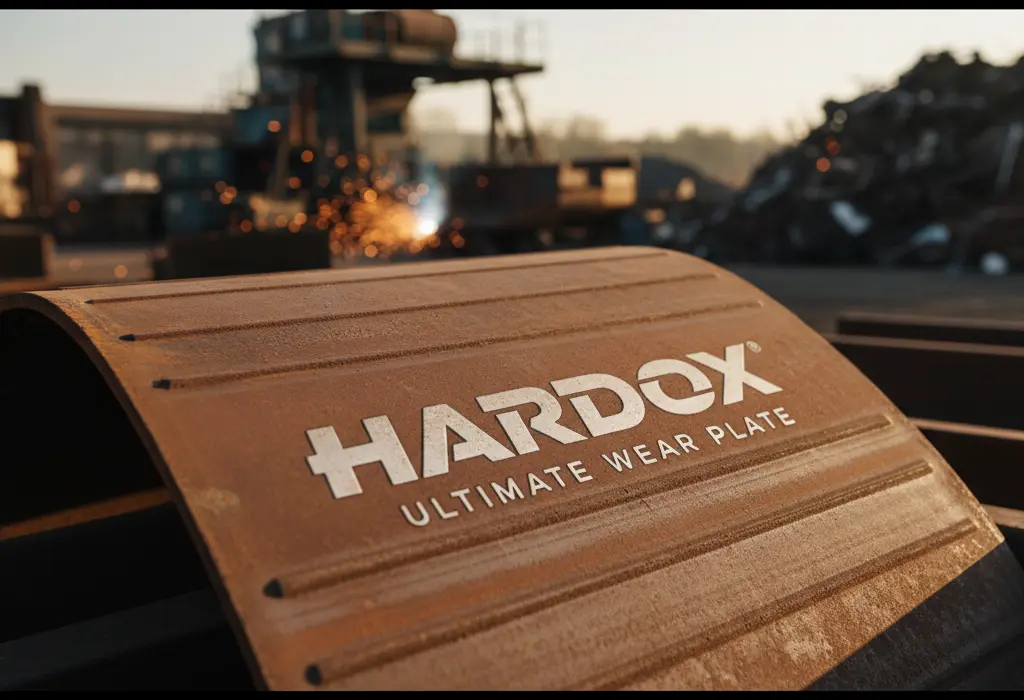
Hardox sheets in industrial machining and high-wear applications
When you talk about Hardox sheet metal you are choosing a hardened wear-resistant steel designed to withstand abrasion, impact, and repeated loads where a standard sheet metal would be worn out in a short time.
This immediately changes the perspective of those running a plant, a carpentry shop or a fleet of caissons and buckets: the material has to be designed and processed with different parameters throughout the cycle, from cutting to bending to welding. Before choosing Hardox over traditional sheet metal, you need to understand how it really performs on the shop floor and what advantages it brings in operation.
| Parameter | Hardox sheet metal | Standard sheet metal | Effect in production |
|---|---|---|---|
| Hardness | Very high (wear-resistant) | Low to medium | Higher resistance to abrasion, more demanding cutting |
| Tenacity | High, impact-resistant | Variable according to quality | Less risk of sudden breakage in operation |
| Thicknesses | Reduced thicknesses can be used | Greater thicknesses required | Lighter components for equal durability |
| Machinability | Most critical in cutting, bending, welding | Manageable with standard parameters | Requires expertise and integrated process |
| Service life | Far superior in wear and tear | Limited in abrasive environments | Less plant downtime and replacement |
Already from this picture, it is clear that Hardox is a material that makes sense where sheet metal works “under attack” continuously: loading belts, bin walls, hoppers, blades, internal plant linings. But the same hardness that provides durability makes it more delicate to work with. This is where the choice of partner matters more than the material: those who manage development, cutting, bending, and welding in a single supply chain, with an adequate fleet of machines and true product industrialization, can take advantage of Hardox sheet metal without turning it into a source of trouble on the workbench.
What Hardox sheets really are and why they are not a simple metal sheet
A standard metal plate is chosen to support loads, provide some rigidity, and meet dimensions and tolerances; a Hardox plate is chosen to withstand wear and impact where other materials wear out too quickly. The difference is not just in hardness numbers: it is in the philosophy with which the material is put on the machine. A structural steel such as an S235 or S355 is machined with relatively tolerant parameters; a wear-resistant such as Hardox, hardened and tempered, on the other hand, requires attention to heat concentration, deformation, and internal stresses.
From the point of view of designers and builders, this means that Hardox makes it possible to reduce thicknesses and lighten components while maintaining a much longer service life in creep and impact zones. But it also means it makes no sense to think of it as a universal replacement for “sheet metal”-it works where wear is the critical variable, while in neutral or low-stress areas good structural steel remains the most rational solution. Value is achieved when Hardox sheet metal is used as part of a tailored sheet metal, inserted in the right places in the component and machined with a consistent technical path.
Hardox 400, 450, 500 and beyond, what changes in the workshop
For plant or bucket designers, the acronyms Hardox 400, 450, 500, and higher grades are not commercial details: they define the trade-off between hardness, toughness, and machinability. Hardox 400 is often the first step, because it combines good wear resistance with workability that is still manageable in cutting and bending; Hardox 450 increases durability but already requires more attention in bending and welding; Hardox 500 and above take abrasion resistance to very high levels, but become more demanding in terms of minimum radii, weldability, and machining.
The key point is that each jump in hardness brings with it a greater susceptibility to process errors. Too slow an entry in the cut can overheat the edge; too tight a bend radius can generate micro-cracks not visible to the naked eye but ready to turn into cracks in service; uncontrolled heat input welding can compromise hardness in the thermally altered zone. These are all situations where the material is not “forgiving,” and where the way of working matters at least as much as the choice of Hardox grade.
Comparison of Hardox and standard metal sheets in real applications
The question a plant manager or carpentry owner rarely asks is “how hard is the steel?” and much more often “how long does the component last me and how often do I have to stop the line to replace it.” In this sense, a
| Zone / component | Main stress | Standard sheet metal | Hardox sheet metal | Operational indication |
|---|---|---|---|---|
| Body walls and buckets | Abrasion from loading and unloading | Fast wear and tear | Much longer service life | Prefer Hardox with reduced thickness |
| Hoppers and Chutes | Abrasive material flow | Frequent replacements | Increased service life | Apply Hardox to critical areas only |
| Load-bearing structures | Static load | Sufficientstructural material | Not always necessary | Standard sheet metal more rational |
The choice, then, is not “Hardox yes or no,” but “where Hardox makes sense and where well-managed sheet metal is more than sufficient.” In many cases, the best solution is a combination of materials: structural parts in traditional steel, surfaces exposed to wear in Hardox, all designed from 3-D models that take into account thicknesses and subsequent machining, as is done in
Hardox sheet metal cutting in process optics
Cutting is the first test of how well you really know the material. A Hardox sheet can be cut by laser cutting, plasma cutting, or traditional technologies, but each choice has direct implications for edges, deformations, and quality of subsequent steps. Laser allows precise tracking even on complex geometries, but the concentrated energy can generate local stresses if parameters and cutting strategies are not calibrated. Plasma is more suitable for high thicknesses, at the expense of a less fine edge that often requires additional machining.
From an industrial perspective, the goal is not just to “pass the part”: it is to ensure that that edge holds a crack-free bend or a crack-free weld. The logic applied in laser cutting processes from an industrial perspective becomes even more critical on Hardox, where there is little room for error. Reasoned nesting, scrap management, and attention to the cutting sequence do more than save material-they serve to prevent a weakened area from compromising the next cycle.