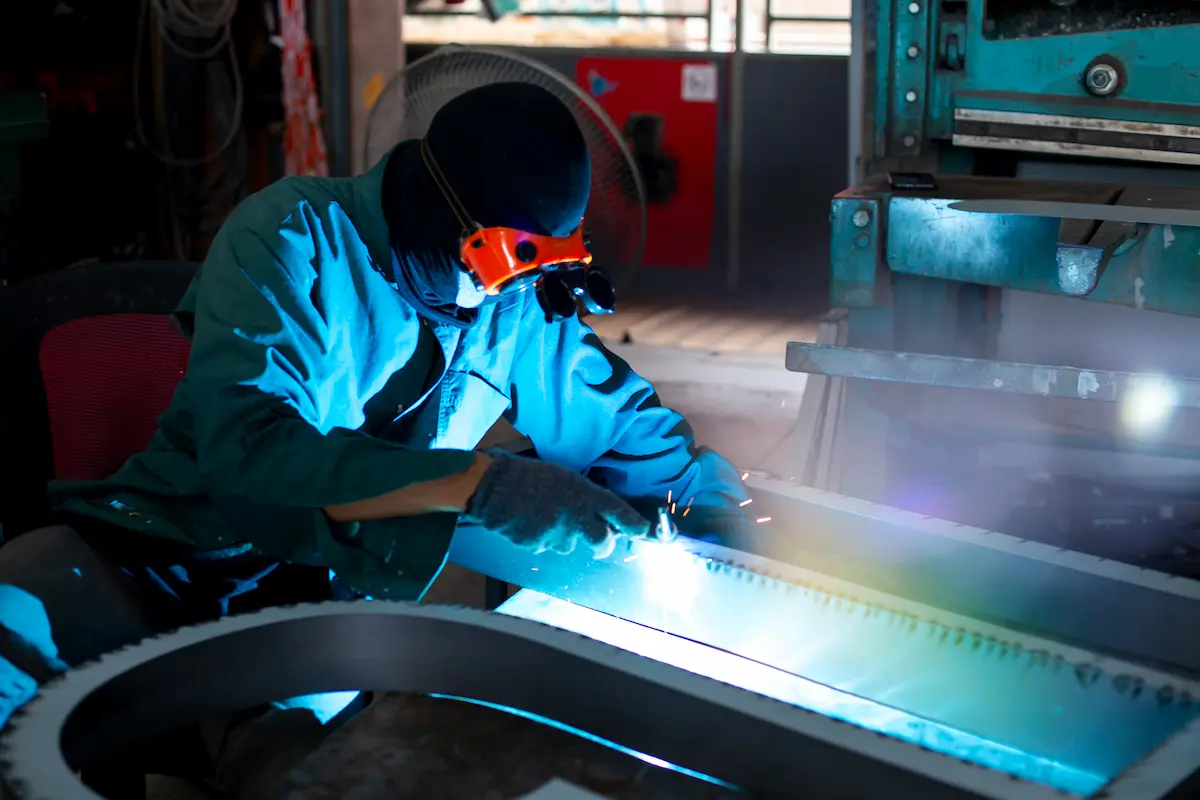
Welding galvanized sheet metal as a process decision and not as a simple joining operation
Welding galvanized sheet metal means facing a technical balance where zinc layer, thermal behavior of the material, and sequence of processing cannot be separated. Galvanizing was created to protect steel, but it introduces a heat response that profoundly changes the
Zinc melts and vaporizes much earlier than steel; this temperature discontinuity generates two critical phenomena. On the one hand, the formation of nonwettable oxides that hinder the adhesion of filler metal; on the other, the overpressure created by vaporization that traps gases and produces porosity and microcracks in the bead. The thermally altered zone is larger and less controllable than in an uncoated sheet, and the bead tends to show penetration irregularities, inclusions, and local melt variations. When the operator sees bulges, cavities or a dull, grainy bead, he is reading the typical signature of a process that has not governed the interaction between heat input and galvanized coating.
In the actual flow of a metal fabrication shop, the welding of galvanized sheet metal should be considered from the design of the part. A fold obtained by press bending creates areas susceptible to thermal shock; a thin edge generated in punching can lose stability when zinc burns unevenly; a laser cut too close to the weld zone already alters stress distribution. Therefore, welding becomes an integral part of product industrialization: it defines time, cost of anticorrosive restoration, and aesthetic and functional quality of the next step.
It is in this logic of – cutting → deformation → joining → finishing – that the choice of welding process on galvanized sheet takes on an industrial sense, avoiding corrective interventions downstream and ensuring continuity between design and production.
How zinc reacts to heat and what it means for joint stability
The response of zinc to heat imposes a sharp distinction between what is technically feasible and what is productively viable. With hot dip galvanizing the layer is thicker and more irregular: vaporization is intense and the likelihood of oxide inclusions increases, especially on long or multi-pass beads. In electroplating, the layer is thinner and more manageable, but the thermally altered zone remains vulnerable and still requires
When the melting bath is disturbed by zinc.
The choice of joining technology must start by reading the behavior of the bath. MIG welding provides speed and productivity, but highlights the limitations of zinc: spatter, porosity and lack of fusion emerge when the coating is not managed or when the heat input is excessive. GTAW, more controlled and precise, allows clean beads on thin gauges, but is even more sensitive to vaporization, requiring high purity gas and modulated energy control. A simple rule applies in both cases: if the pool is disturbed, defect is not a risk but a certain outcome.
Braze welding as an intermediate solution
In many productions, braze welding with CuSi3 alloy represents an intermediate route: the lower temperature partially preserves the coating and limits defect formation, while generating a less structural joint than full soldering. It is a rational solution when the component is not load-bearing, when the priority is to reduce distortion, or when aesthetics prevails over mechanical strength.
In a context that integrates sheet metal working and robotic welding, this choice brings stability: less fume, greater repeatability, reduced rework. However, it remains a process to be applied only where the function of the part permits.
Effects of zinc on already deformed geometries
The crucial issue is how the presence of zinc interacts with already transformed geometries. A bent plate has a stress gradient that makes the area near the inner or outer radius more sensitive to thermal shock: microcracking is more likely to occur here.
A punched sheet, especially one with long slots or close holes, can deform as soon as the coating burns unevenly. A laser cut too close to the future weld generates hard edges that react badly to heat input. Therefore, welding on galvanized should never be read in isolation, but as part of a sequence of actions already performed on the part.
Welding and industrialization of the part
Each operational choice must be integrated with product industrialization criteria. The sequence cut → fold → joint → finish must be defined before selecting the welding process. A component intended for aesthetic painting requires controlled removal of zinc in the joint area to ensure adhesion in the finish. A structural component, on the other hand, focuses on the
Why zinc management before soldering decides half of the final result
When galvanized sheet metal enters the weld without prior assessment of the area to be cleaned, the thickness of the coating, and the interaction with past strains, the process takes on variability that no operator or robot can compensate for after the fact. Selective removal of zinc, through localized grinding or brushing, is not to “improve” the weld, but to prevent the formation of nonmetallic inclusions and gas pockets that compromise penetration. Every millimeter of material removed is a lost layer of protection that will need to be restored, and here experience shows that the amount of zinc burned off almost never coincides with the amount of coating that needs to be replenished. It is a theme that also returns in
Bath behavior in real joints and not in textbook cases
In carpentries machining series of parts, the melt bath never behaves as it does in sample tests. The presence of laser-cut edges with hardened areas, narrow radius bent flaps, and holes made with worn punches produces differences in heat absorption that alter bath viscosity appreciably.
On galvanized sheet metal this effect becomes more pronounced because the vaporization of zinc generates a micro-turbulence that intermittently destabilizes wettability.
This is why a bead can be aesthetically acceptable for 20 cm and suddenly show irregular cavities in the next section: it is not operator error but a local variation in the burning of the coating. In machining operations that incorporate robotic welding, these discontinuities are read as repetitive defects, forcing the production manager to revise parameters or introduce pre-treatments that lengthen the cycle.
Reading distortion as a process indicator, not a defect
Distortion of welded galvanized sheet is a direct consequence of the thermal gradient and not an individual error. Zinc, behaving as a low-viscosity fluid when it vaporizes, transfers heat abnormally toward neighboring flaps, accentuating the phenomenon.
The deformation becomes more noticeable when the sheet metal was previously bent: the material, stiffened along the inner radius, resists expansion and deflects heat to the outer surface, creating asymmetrical behavior. In terms of the production cycle, this translates into a higher need for straightening at the
When it is appropriate to solder, when it is appropriate to braze, when it is appropriate to avoid heat altogether
The most common mistake is to think that the choice of technique depends only on the thickness or type of joint. In reality, the correct question is: What function will the piece serve and in what environment will it work?
MIG welding with partial zinc removal is adequate for structural components subject to continuous stresses; GTAW, while cleaner, should be evaluated only when the geometry and coating allow control of heat input without degrading zinc in an uncontrolled manner.
CuSi3 braze welding, on the other hand, becomes strategic when the goal is to contain distortion, preserve part of the coating, and achieve a smooth bead on thin thicknesses. Finally, there are cases (aesthetic casings, lightweight crankcases, thin panels) where a mechanical bond, resistance tacking, or clinch bonding are simply more stable and less expensive, especially if the part will go through final coating anyway.
Help to read the behavior of galvanized sheet metal in welding
| Thickness | Galvanizing type | Recommended technique | Expected criticality | Process Notes |
|---|---|---|---|---|
| 0.8 to 1.5 mm | Electrolytic | TIG / CuSi3 | Porosity, distortion | Reduce heat input, prepare edges |
| 2 – 3 mm | Hot | MIG | Intense steaming | Remove zinc 15-20 mm around |
| 3 – 4 mm | Hot / duplex | Pulsed MIG | Inclusions, spattering | Controlled heat input, reduced pendulum |
| > 4 mm | Thick hot | MIG / arc spray | Gas trapped in the cord | Edge preparation + light pre-heating |
Anti-corrosion restoration: what really determines the life of the part
Welding on galvanized without anticorrosive restoration is a one-piece process: the thermally altered zone becomes the weak point of the entire structure. Zinc-rich primers, cold galvanizing and some epoxy paints succeed in compensating only if applied immediately after mechanical cleaning of the bead, when the surface has not yet formed secondary oxides.
Here the quality of the satin or micro-pallination affects the continuity of the protective film: inconsistent roughness creates areas of lower adhesion, which in salt spray tests turn into filiform corrosion. It is not an aesthetic detail, but a parameter that defines the useful life of the part in the weeks and months after delivery.
Closing the process means controlling every step, not just welding
Welding galvanized sheet metal is a technical decision that involves the entire production flow. It means defining the extent of coating removal, predicting distortion, correcting machine parameters, organizing ventilation of the area, and determining how the final finish will be done. Above all, it means integrating joining into the design logic: a component well thought out to be welded on galvanized requires less rework, generates less scrap, and has fewer defects in dimensional and corrosive verification. In other words, welding is never a matter of welding: it is a matter of consistent process involving cutting,