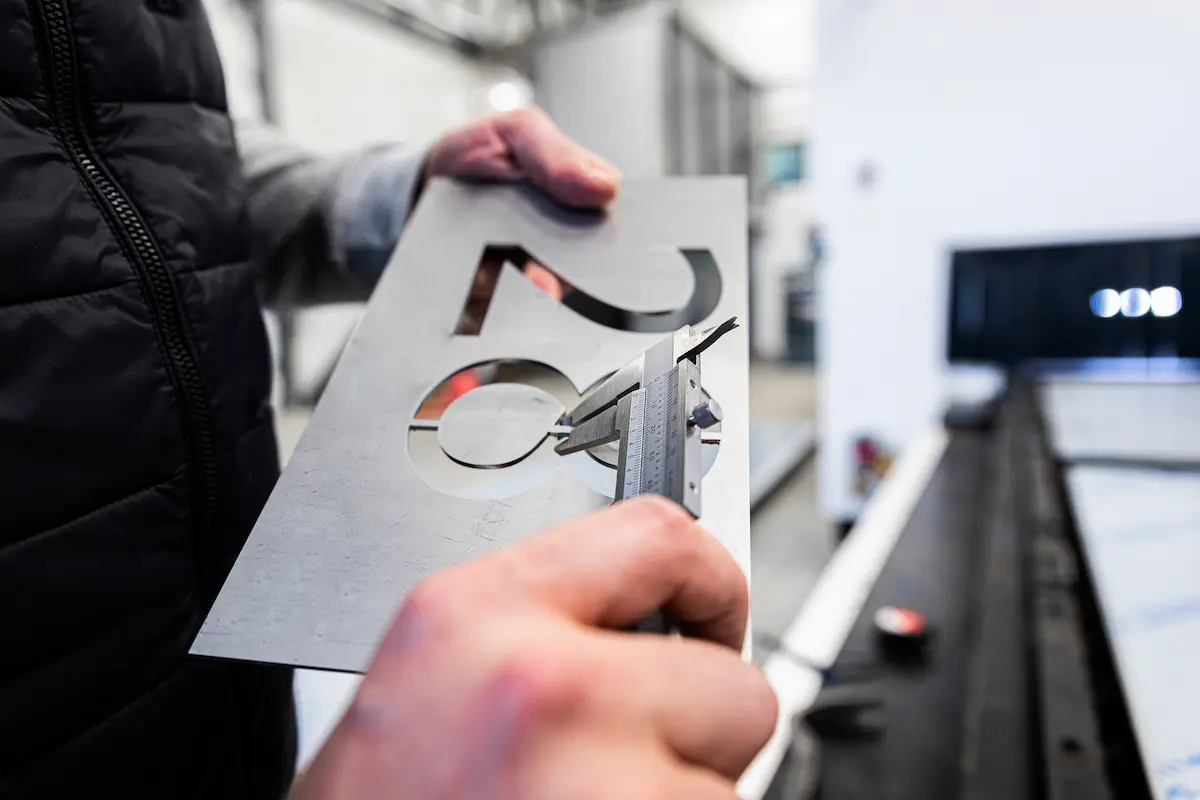
Sheet metal plotting meaning and technical guidance for development, cutting and production
Sheet metal tracing is the operation by which the lines that will define the development, cutting and subsequent transformation of the sheet metal are drawn on the metal sheet, creating a stable reference for all production stages. It is a step that directly determines the quality of the final part because each mark drawn guides folds, holes, profiles and fits, influencing the behavior of the material in the
Tracing can be done manually, using drills, rulers, compasses and measuring tools, or integrated into machine paths through CNC cutting systems that directly transform the drawing into a cutting path. Despite the widespread use of automation, manual tracing remains indispensable in prototyping, developmental testing, and irregular geometries because it allows the actual behavior of the material to be assessed before more invasive processes. The relationship between tracing and final geometry is never trivial: even small differences in initial references produce significant effects in deformation, especially when the part requires close bends or precise curvatures.
What is sheet metal tracing and why it is decisive for development
Sheet metal tracing involves drawing a series of references on the material that guide the entire production cycle, from cutting to forming to eventual welding. The lines can identify outer contours, hole locations, axes of symmetry, bend references, and points where the sheet metal will change shape or direction.
In modern systems, plotting is incorporated into nesting software, which optimizes material utilization and generates plots consistent with required tolerances. In shop-floor and carpentry contexts, however, manual tracing remains a crucial activity to check that theoretical development matches the practical requirements of the actual part, especially when the material has slight undulations or when surfaces need to be checked before cutting.
Good tracing stabilizes the production flow because it anticipates any interference between folds, radii or joint lines. In parts requiring multiple deformations, tracing becomes an indispensable guide to correctly position the sheet on the fixtures and to avoid displacement during the cutting phase. It is at this stage that key concepts such as consistency of clearances, visibility of the tracing, and compatibility with sheet development emerge, all of which become crucial to obtaining repeatable and dimensionally correct components.
How sheet development is calculated and what role it plays in plotting
Sheet metal development represents the flat dimension required to obtain the final geometry after bending, curving, or other processing. It is a step closely related to tracing because all lines drawn on the sheet must respect the actual lengths that the sheet will take when deformed.
The key variable for calculating development is the K factor, which defines the position of the neutral layer within the thickness. This value determines which portion of the material does not undergo elongation or shortening during bending, providing the basis for calculating arcs, inner radii, and resulting lengths.
In practice, the actual development is derived from the sum of the plane lengths and bend sections calculated from the thickness, angle and inner radius. An error in K-factor or radius evaluation results in deviations that are amplified in later stages, especially when the part requires many bends or fillets.
This is why tracing must adhere strictly to theoretical development: a line shifted by a few tenths becomes an out-of-gauge fold or a weld fit that is more difficult to close. The integration of development, tracing and cutting is therefore one of the key points of the production process.
How to cut sheet metal after plotting and what techniques are most effective
Sheet metal cutting translates the outline into actual shape. The most commonly used techniques depend on the geometry, thickness, and material.
- Laser cutting provides high precision and clean edges even on complex shapes, ensuring accurate control in components involving close folds or sensitive fits.
- Plasma cutting is used when thickness increases and higher speeds are needed, while shearing finds application in linear cuts on medium-sized sheets.
- Stamping, on the other hand, allows rapid mass production through dies, ensuring high repeatability and low cost in significant volumes.
Perfect adherence between tracing and cutting is essential: an inaccurate tracing cannot be compensated for by cutting techniques and produces out-of-gauge parts. The link between tracing and cutting method is particularly evident in parts that require successive stages of carpentry, where a variation of a few tenths can generate tension after welding or difficulties in assembly. The quality of the edge also affects the legibility of the residual tracing, because burrs, oxides or heat deformation can alter references in subsequent machining steps. For this reason, the choice of technique must take into account the type of trace, the required tolerances, and the production sequence.
What technique to use to produce sheet metal based on materials, thicknesses, and geometries
The choice of the most suitable production technique depends on a combination of elements: sheet extension, thickness, profile complexity, and the quantity of parts required. Thin materials with elaborate geometries find laser cutting an ideal balance between precision and edge cleanliness, while higher thicknesses or high volume production push toward plasma or blanking. Aluminum requires techniques that minimize thermal deformation, while stainless steels need controlled parameters to avoid oxidation and residual stresses. The goal is to maintain a consistent production flow in which drawing, cutting and any bending or welding follow one another without introducing dimensional variations.
| Material | Thickness | Recommended technique | Operating Notes |
|---|---|---|---|
| Carbon steel | 1-12 mm | Laser or plasma | Good compromise between speed and quality |
| Stainless steel | 1-6 mm | Laser | Reduces warpage and burrs |
| Aluminum | 1-8 mm | Laser or stamping | Avoids heat deformation |
Typical defects in plotting and sheet metal cutting and operational controls
The most common defects in tracing involve non-orthogonal references, poorly visible lines, errors in centering points and deviations from theoretical development. These errors emerge especially in parts intended for bending, where a poorly drawn line turns into an out-of-round bend or a hard-to-weld fit. Cutting can also introduce defects: burrs and deformations in mechanical cuts, thermal alterations in laser or plasma processes, and dimensional differences due to poor head adjustment or a non-optimized path.
- Geometric misalignments between plotted lines and actual development.
- Residual burrs and marks from non-optimized cuts.
- Thermal deformations in high-temperature processes.
- Loss of track visibility due to oxides or impurities.
Integration of tracking into production flow and industrialization
Tracing is an integral part of the machining flow because it establishes the basic references for all subsequent operations. Tracing consistent with sheet metal development allows folds, cuts and fits to be set correctly, reducing the need for manual corrections.
Integration with CNC cutting systems makes it possible to transfer the track directly into the machine path, reducing errors and improving edge quality. In industrialization cycles, standardization of tracing and digital management of blanks make the transition from prototype to production faster, ensuring consistency between departments and reducing scrap.
Impact of tracking on final component quality
Plotting done with technical logic reduces errors in the cutting and bending stages, ensures continuity with theoretical development, and allows tight tolerances to be maintained in assemblies. The quality of the final component depends on the accuracy with which the lines are reported and how they guide the operators in the subsequent steps.
When plotting, developing and cutting are seamlessly integrated, the production flow becomes stable, predictable and more efficient, especially in processes requiring complex geometries or high-precision weld fits.