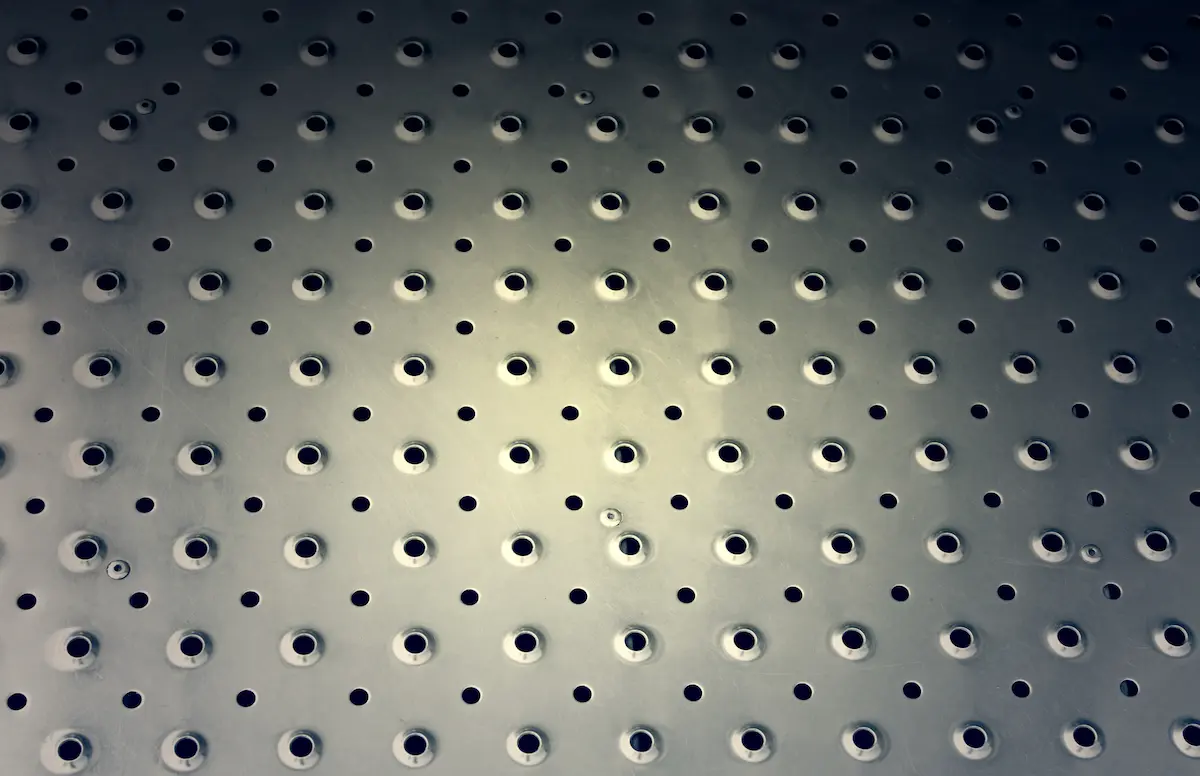
Stainless steel flake sheets and behavior in carpentry processes
Florescent stainless steel sheets bring to the shop floor a surface that, at first glance, seems like just an aesthetic choice. In reality, it is a texture that changes the way the sheet moves on the machines, reacts to stresses, and allows itself to be worked into the next steps. Variable friction, micro-asperity, roughness distribution: tiny details that nevertheless affect laser cutting, bending, and welding, especially when the component must maintain stable geometries until assembly.
And when you put it side by side with an aluminum almond plate, the differences emerge not only in weight and stiffness, but also in how each interacts with the complete production cycle.
How the florescent surface is formed and what it implies about the properties of stainless steel
Flourishing results from a controlled pattern micro-abrasion treatment. The sheet metal (AISI 304 or 316) comes out of rolling and undergoes a sequence of abrasive passes that create a fine, uniform, diffuse pattern. This is not an almond or ashlar pattern: it is a fine texture involving only a few micrometers of material but changing the behavior of the sheet in subsequent passes. The passive film of the stainless regenerates, but the roughness remains and interacts with pressures, drags, and presses.
The industrial logic behind flowering
The treatment alters the micro-topography and thus the manner in which the sheet:
- Slips on machine floors,
- Is engaged by the rollers,
- deforms under a matrix,
- Dissipates heat in soldering.
These are not macroscopic changes, but in daily work they significantly change real angle, elastic response, and edge quality.
Smooth versus flowered foil in the production cycle
The difference is not so much in mechanical strength as in “operational friction.” A smooth sheet of metal rests and flows smoothly; fluting introduces a slight gap in surface continuity, and this makes any transition requiring geometric precision more sensitive.
Typical effects:
- Micro-slips on the laser pallet,
- Variable grip of rolls or referencing,
- Slight variation of the true radius in bending,
- Wider thermally altered zone in welding.
It does not change the structure of the material, but it does change how the machine “reads” the surface. This is the same dynamic found when working on surfaces that have already been treated or where plotting must account for local unevenness.
Behavior of stainless steel sheet flared in cutting, bending and welding
Flourishing does not alter the elastic modulus or ductility of stainless steel, but it affects everything that depends on the contact surface. For those working with concatenated cycles (cutting → bending → welding → finishing), this is something that can be felt from the first time the machine is taken off.
Laser cutting and micro-asperity management
Micro-incisions maintain a slightly discontinuous surface, and this changes the laser behavior. Nothing that prevents good cutting, but it requires more control:
- Less full contact with the pallet supports,
- Slightly lower stability in thin sheets,
- Stronger adhesion than melting powders,
- Need for more thorough blowing and cleaning.
Those who work daily with laser-cut panels recognize the phenomenon: the material “vibrates” differently, requiring slightly more cautious settings in power and feed rate.
Fold between effective radius, pressure, and interference
In bending, the flowered surface introduces more friction, and this changes the fiber distribution in tension and compression. The result is a true angle that is more sensitive to changes in:
- matrix quarry,
- Punch geometry,
- thickness and type of stainless,
- springback.
On technical parts (flanges, frames, stiffeners), the operator sometimes prefers a slightly more open keyway or higher contact pressure to compensate for surface adhesion. This is similar behavior to that observed in bends on satin finish, where the “treated” surface makes the angle more sensitive to tool micro-variations.
Welding and management of the thermally altered zone
When switching to welding, flaring changes heat dissipation and bead continuity. GTAW remains more accurate, while GMAW can incorporate residue or imperfections if the area is not carefully prepared.
In fact, before welding there is a tendency to:
- Restore a small smooth band with fine brushing,
- Remove residue from laser cutting,
- Clean the bead to promote reconstruction of the passive film,
- Check for any color change in the stainless.
This is the same cautious approach taken when working on special surfaces, such as in welding galvanized sheet metal, where the surface is not neutral and requires dedicated preparations to ensure quality and repeatability.
When aluminum almond sheet metal becomes a practical alternative
Aluminum aluminized sheet is not the “light version” of floriated stainless: on the shop floor it follows completely different logics of behavior. The relief is not a finish but a structure, and what looks like a simple surface pattern becomes an element that stiffens the sheet, conditions the minimum radius that can be achieved, and changes the way the material flows under tools and rollers.
In components that need to be moved or integrated into lightweight frames, mandorling offers a balance between low weight and flexural strength that stainless cannot match, but it requires a production cycle built around its more ductile and thermally sensitive nature.
Weight, stiffness and forming behavior of almond aluminum
Aluminum, with its specific gravity about one-third that of steel, makes the sheet manageable even in large formats. But mandorlating introduces a directionality that the designer must consider from the outset: bending along the relief allows for different control than transverse bending, because the effective thicknesses vary and the neutral zone shifts non-symmetrically. In applications such as footplates, service tops, or machine engineering panels, this feature becomes an advantage; in parts with complex geometries and succession of close bends, however, it requires the same caution as in 3D sheet metal design, where each surface has direct effects on deformation.
Welding amplifies these differences: aluminum absorbs and spreads heat rapidly, and with the reliefs interrupting the continuity of the material, the thermally altered zone takes on uneven behavior. The bead tends to “pull” the part more than on flashed stainless, requiring a more balanced joint distribution and progressive cooling to avoid visible warping even after the first pass.
It is a way of working that those who work with lightweight frames know well: excellent results, as long as you drive the deformation rather than undergo it.
Direct comparison of flowered stainless and almond aluminum
Direct comparisons between the two materials are clearer when critical variables in the production cycle are placed side by side. The table is not a substitute for shop floor experience, but it allows you to see how each surface choice affects cutting, bending, welding and final stability. It is a quick way to evaluate which material responds best to the type of part and the intended sequence of machining.
| Parameter | Flowered stainless | Almond aluminum |
|---|---|---|
| Cutting behavior | Uniform surface, constant absorption; requires only thorough post-laser cleaning. | Reliefs more sensitive to vibration; more attention to blowing and leaning. |
| Response in folding | Moderately higher friction; stable true angle even with multiple folds. | Directionality of relief; larger minimum radius and strong sensitivity to residual stress. |
| Weldability | Predictable TIG and MIG; passive film that rebuilds quickly. | High heat dissipation; risk of deformation if joints are not distributed. |
| Corrosion resistance | Very high, especially in AISI 304/316. | Depends on the alloy and any protective treatments. |
| Specific weight | Superior, requires solid structures for handling. | Very light, ideal for moving platforms and components. |
| Geometric stability in the cycle | Excellent continuity between cutting, bending and welding. | Greater variability, requires intermediate controls between stages. |
| Preferred applications. | Crankcases, covers, corrosive environments, aesthetic or technical panels. | Footboards, non-slip surfaces, light protection, movable frames. |
Technical comparison of flashed stainless and almond aluminum in industrial applications
Florescent stainless aims for dimensional continuity. Its surface is a fine texture, not a relief: this means that once the bending and welding parameters are set, the sheet maintains a very similar response to smooth stainless, with slightly higher friction but higher overall stability. It is the ideal material for panelling, covers and casings that need to maintain shape and appearance over time, especially when the working environment is exposed to moisture, frequent washing or chemicals.
Aluminum mandrel, on the other hand, meets the opposite requirements: lightness, non-slip grip, and ease of handling. The stiffness increased by embossing allows working with reduced thicknesses without losing stability, but the thermal response remains more delicate, which is why in jobs involving consecutive folds or structural joints it is necessary to monitor the flatness between phases.
This is the classic case of machinery platforms or treads: robust, practical, but achieved by a cycle that actively manages the elastic behavior of the material.
If one looks at durability, stainless (flocked or not) maintains a distinct advantage for resistance to corrosion and permanent deformation; if, on the other hand, the constraint is weight or the need for an easily installed component, almond is more appropriate. For processes that integrate machining on sheet metal or need geometric stability, stainless remains more predictable; for dynamic or mobile applications, aluminum wins for practicality.
Operational guidance for designers and shop floor managers
Surface, in real production flow, is never a neutral element. The flaring of stainless steel introduces slightly more friction, which is most apparent in bending, where approach pressure and tool geometry must be calibrated to achieve a repeatable true angle. However, the material has a stable behavior: from laser cutting to welding, variations remain minimal and easily manageable thanks to a passive film that quickly rebuilds.
Almonding, on the other hand, requires active cycle management. Relief conditions the grip of the sheet in the press brake, changes the actual radius, and makes any residual micro-tension more apparent. This is the same kind of attention needed in
The operational choice, then, is not an aesthetic one but a process one: if the goal is to maintain stable geometries, surface continuity and predictable welds, flamed stainless is the most solid way to go. When, on the other hand, weight, ergonomics and non-slip grip drive the design, almond becomes the most efficient solution. In both cases, the logic is the same as that governing product industrialization processes: anticipate material behavior and build a cycle around it that produces repeatable results.