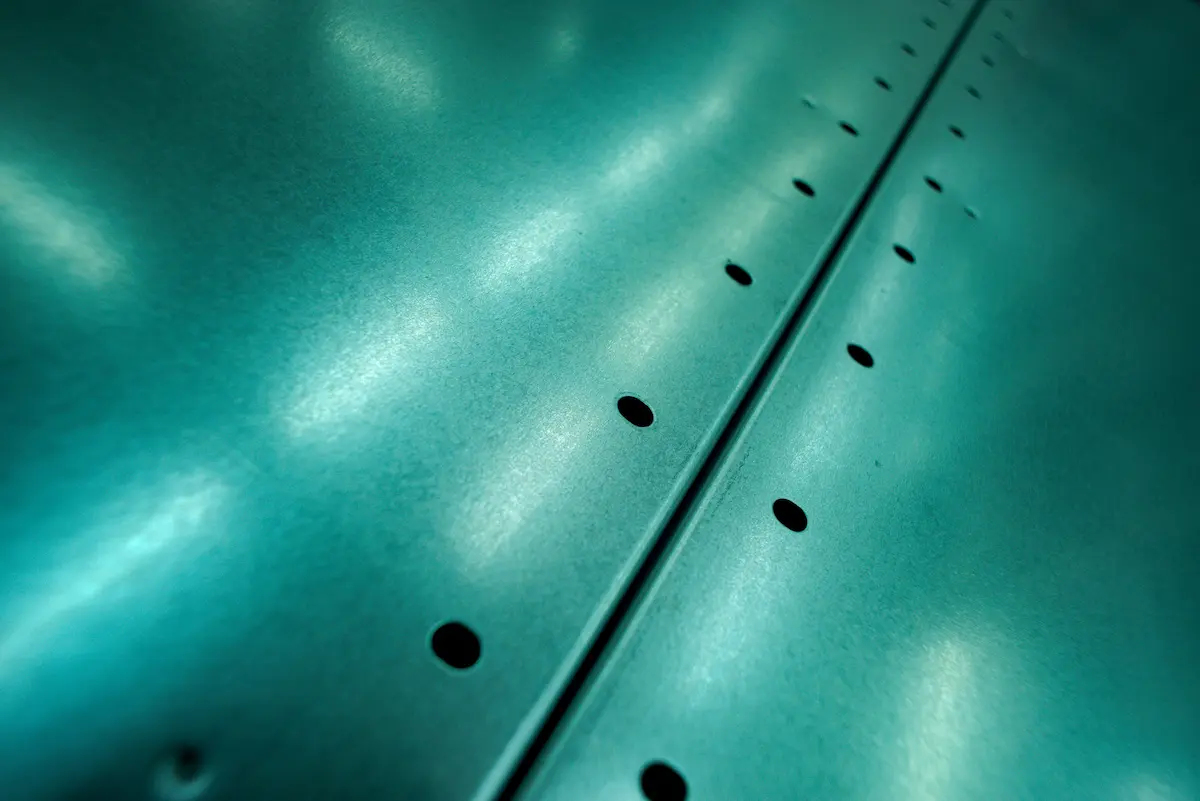
Laser-cut sheet metal panels for technical and custom productions
Laser-cut sheet metal panels are chosen when a precise, repeatable component capable of integrating without surprises into folds, welds or structural assemblies is needed. They are not simply shaped sheets: they are elements already prepared for technical functions, with holes, calls, references and geometries that must remain consistent after each operational step. Laser cutting allows for clean edges and complex shapes, but real quality arises only if the entire process is continuous: how the file is set up, how the heat is handled, how the panel will be treated in subsequent steps. A panel remains stable when the die is coordinated, especially if it is not a rectangle but a piece that will have to “talk” with bending, calendering, and welding.
| Technology | Advantage | Limit | When to use it |
|---|---|---|---|
| Laser cutting | Clean edge and complex geometries | Possible thermal micro-deformations | Technical and custom-made panels |
| Plasma | Excellent on thicker edges | Rougher edge | Heavy structural panels |
| Punching | Shaping, extrusions, reliefs | Limited on very complex shapes | Panels with integrated features |
Many times laser is the most logical choice because of the precision and quality of the edge, but the situation is not always so straightforward: a panel that will be bent needs careful management of heat dissipation, while a panel to be welded requires edge continuity. A partner who manages cutting, bending, and metal seams in a coordinated way (as happens in the flows described in laser cut sheet metal processing in industrial optics) produces panels that are already “thought out” for what they will face next.
How laser cutting defines panel quality
The quality of a panel arises in cutting and, more specifically, in heat management. There are panels that remain perfectly stable and others that move at the first stress: the reason is the different amount of energy absorbed. The fiber laser reduces the thermally altered area, but does not cancel it out: wide, thin panels or those with many openings may experience small stresses that re-emerge in folding or welding. This is why the parameters are not fixed: power, speed, gas and distance of the focus must be calibrated from piece to piece.
If the panel is intended for bending, the cut must respect neutral zones and deformation lines; if it will be welded, the edge must present a continuity that does not alter the fluidity of the bath; if it will be part of casings or roofing panels, the flatness must be checked immediately after detachment from the cutting plane. These are tricks that require experience and true control of the process, not just the machine.
When laser cutting really pays off for panel production
Laser pays off especially when the panel is not a simple rectangle. If irregular shapes, slots, thin holes, or references for subsequent assembly are needed, laser cutting has a flexibility that other technologies do not replicate. The same is true for panels intended to be folded, calendered, or welded: laser produces consistent edges with subsequent machining.
That said, there are situations where lasers are not the first choice: very high thicknesses, out-of-scale panels, highly reflective materials without adequate gases. In these cases, plasma or a combined process may offer more stable results.
Evaluation does not depend on the technology, but on the “history” of the piece: a panel is already born with what it is to become in mind, not the tool that cuts it.
Flat, shaped or functional panels depending on the project
All panels are not the same. The “flat” panel requires dimensional accuracy and stability; the “shaped” panel anticipates a fold or curve and therefore must be cut according to the development, not the final shape. “Functional” panels, on the other hand, include slots, references, invitations or small volumes that can be obtained by punching: elements that transform a simple cut into a technical part.
It is in these geometries that design makes the difference. A hole too close to the fold line can deform; a contour too thin can vibrate during calendering; an invitation out of position compromises a weld. Technical sheet metal drawing logics help prevent these errors before cutting is even started.
Laser cut sheet metal panels and folding, what really changes
When a panel is to be bent, cutting is no longer an isolated operation-it becomes part of the mechanical balance of the part. An edge exposed to too much heat can stiffen the fold area; a poorly set geometry can make the fold itself unstable; a poorly positioned hole risks losing symmetry. The fold must be prepared in the cut.
This is the same principle behind precision industrial bending: anticipate material behavior, read the actual development, and maintain consistency between the cutting line and the bending line. A well-designed panel requires no adjustments: it enters and leaves the press brake with the intended geometry.
Laser sheet metal panels and welding
A lasered panel intended for welding requires even more attention. The edge must be uniform to maintain continuity of the bath; the thickness must remain constant; and
Welding, in fact, is the stage where the panel “shows” everything that has gone before. An unbalanced cut, a less-than-perfect bend, a thin outline-every choice emerges as the metal heats up. This is why integrated fluxes, as in precision sheet metal welding, ensure more stable and consistent panels throughout the production cycle.
Laser cut aluminum panels
Aluminum is a material that looks simple, but as soon as it enters laser cutting it reveals a higher sensitivity than steel.
The real issue, however, emerges in subsequent machining: a panel that is to be bent or welded reacts to heat quickly, and if the cut is not set up correctly, it can lose flatness or warp in seemingly stable areas.
Aluminum requires continuity: those who work with it know that cutting, bending and welding must be aligned from the start. It is a material that does not forgive abrupt transitions or disconnected steps. That’s why aluminum panels work best in processes where the supply chain is unique and each step takes into account the next.
How to choose the ideal process according to the type of panel
| Panel type | Material | Ideal technology | Criticality | Technical note |
|---|---|---|---|---|
| Top | Steel / Stainless | Laser | Flatness and edge | Detachment control from the plane |
| Shaped | Steel | Laser/Plasma | Contour fragility | Consistent cutting with development |
| Functional | Steel / Aluminum | Laser + Punching | Slots and reliefs | Provide for local forming |
Why you need a partner who really manages the whole cycle
A panel can be flawlessly cut and become problematic as soon as it enters the fold. Or it looks stable after folding and deforms at the first welding points.
The result is a component that accumulates minimal errors, invisible at first, but multiplying in assembly.
A single die, on the other hand, connects everything: cutting prepares the bend, bending anticipates the weld, and welding respects the stresses introduced earlier.
This is the same logic we find in custom machining for technical assemblies, where each stage originates as an extension of the previous one. This approach reduces rework, maintains shape and allows the panel to be worked on with technical continuity.
In FGM’s method of operation, this continuity is part of the process: every choice about cutting is made with what will happen next in mind. It is a different way of building the panel, closer to a project logic than to single-step production.
Stability of laser-cut panels throughout the production cycle
A laser-cut panel may look like a simple component, but each successive step puts it to the test. Cutting determines how clean the edge is, bending reveals any residual stresses, and welding shows how well the panel was prepared from the beginning. When these steps do not communicate, the panel loses stability; when they are designed together, the panel retains form and function throughout the process.
It is the consistency between processes that transforms a sheet metal into a reliable technical element: precise cutting, correct development, consistent folds, controlled welds.
An integrated path, the one that is applied daily at FGM, allows panels to maintain their intended geometry and adapt to the most rigorous production cycles without requiring unnecessary corrections.