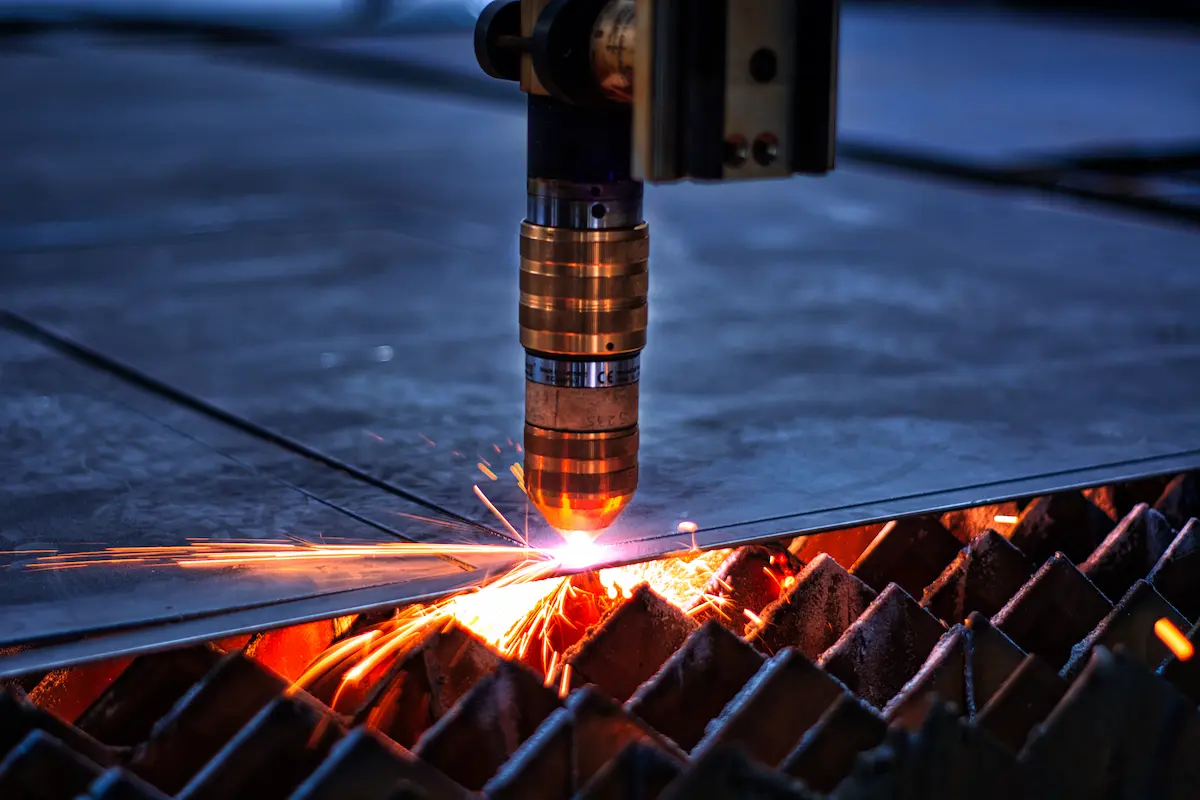
Steel sheet cutting for technical productions and custom machining
In steel sheet metal cutting, it is not the machine that makes the difference, but the way the material reacts to heat, pressure, and the sequence of successive processes. Steel, unlike other metals, maintains a high stiffness that is only partially changed during cutting, meaning that edge quality, dimensional stability, and the thermally altered zone directly affect bending, welding, and mating. For this reason, many production managers look not only for precise cutting, but for a process that remains consistent with the entire sheet metal cycle. Even in the early stages of an engineering project, it is useful to compare technologies, because each distributes energy differently.
| Technology | Typical thicknesses | Edge quality | Criticality |
|---|---|---|---|
| Fiber laser | Up to 25 mm | High, minimal burr | Thermal storage on dense geometries |
| Plasma | 20-40 mm | Medium | Less clean edge, trimming needed |
| Ossification | 40 mm and above | Variable | Important thermally altered zone |
This first comparison is not to choose a technology, but to understand that the quality of the cut depends on the relationship between power, material, and part development. A panel intended to be bent needs a different edge than a component that will be welded at full penetration, just as a carbon steel responds differently than a thin stainless. The choice must take into account the entire cycle and not just the initial removal, because any defect left by cutting is amplified in subsequent stages.
What really defines quality in steel sheet metal cutting
In the shop we often talk about clean edges, but the quality of steel cutting is a combination of elements working together. The edge must be stable, without micro-grooves that interfere with bends or generate aesthetic defects. The
The parameters that define the quality perceived by those who work with steel on a daily basis are clear:
- Edge accuracy and absence of irregularities even on internal cuts;
- dimensional tightness within the same production batch;
- Shear stability in areas of high geometric density;
- repeatability of the templates, especially in the components that will be assembled.
These aspects become even more critical when the part requires subsequent controlled bending. Minor errors in cutting alter the behavior of the material during deformation, as happens in designs that rely on logic similar to that applied in industrial bending.
How steel behaves during cutting
Steel does not react uniformly to thermal processing. Carbon steels absorb energy well and maintain good lateral stability, while stainless steel-especially in polished finishes-reflects some of the beam and tends to heat more unevenly. This affects the maximum achievable speed, edge quality, and tolerance management near complex tracks.
In thin thicknesses the thermal effect can create slight deformations, while in higher thicknesses the problem becomes burr control. In technical components that require precise welds, as is the case in productions processed using MIG/TIG techniques, edge stability directly affects the cleanliness of the joint. This is where laser cutting on sheet metal offers better results: the heat is concentrated and the edge remains more uniform even on complex shapes.
Laser cutting on sheet metal and when it becomes the most effective solution
Laser cutting is today’s most versatile technology for sheet steel because it combines precision and speed, especially when the geometry is not linear. Shops that process complex parts or have to handle many variations find in the laser a balance that plasma, oxyfuel, and shear cannot offer. The ability to maintain narrow paths, make micro-cuts, and handle very small holes without deformation makes it preferable in any production where the part will later be bent, calendered, or finished.
Cases where the laser brings a clear benefit include:
- geometries with closely spaced holes or very precise internal cutouts;
- Mixed lots with different templates but same starting sheet;
- components intended for folding, where edge cleanliness is critical;
- parts intended for calendering, which require uniformity throughout development.
The quality of the fiber laser makes it possible to achieve stable results even in patterns that require many changes in direction. It is a feature that comes in handy in components generated from custom laser designs, where the complexity of the path is an integral part of the design.
Operational comparison of cutting technologies for steel sheets
When it comes to steel sheet metal cutting, it is not enough to know the machine: you need to understand how each technology distributes energy and what effects it has on the surface. Fiber laser has become the dominant solution for complex geometries and low-to-medium thicknesses, plasma retains its relevance in the most demanding thicknesses, while oxyfuel remains essential for cuts beyond certain thresholds. Shear continues to be unbeatable for linear cuts and high repeatability production, although it is not suitable for articulated paths. Properly evaluating these technologies allows the process to be set up from the end result, not from the available machine.
| Technology | Indicated thicknesses | Edge quality | Speed | Operating Notes |
|---|---|---|---|---|
| Fiber laser | 0.5-25 mm | High | Very high | Good for complex geometries and small holes |
| Plasma | 10-40 mm | Medium | High | Requires finishing for aesthetic components |
| Ossification | 40 mm and above | Variable | Medium | Wide thermal zone, ideal for heavy thicknesses |
| Shear | Up to 10 mm | Very good | Very high | Linear cuts only, no profile |
The choice of technology is never abstract: it depends on the type of steel, the presence of holes near the edge, the length of the part, and how much heat the material can absorb without deforming. In parts destined for bending or calendering, the priority is to maintain a smooth surface, without edge alterations that could compromise development. In parts with high technical value, process variability is what distinguishes a good cut from a truly industrial cut.
Real operational criticalities in steel sheet metal cutting
Those who work with sheet metal on a daily basis know that some critical issues do not depend on machine power, but on the combination of material and geometry. Patterns that concentrate many lines in a small space heat the part unevenly; small holes on large thicknesses require precision in gas handling; open templates can vibrate during machining causing edge variation that is difficult to detect by eye.
The most common critical issues include:
- Very small holes on large thicknesses that generate burrs that are difficult to remove;
- Close internal cuts that amplify thermal storage;
- silhouettes with sudden changes of direction that require speed control;
- thin, unsupported areas that may vibrate during cutting.
These points become especially critical when the part is to subsequently undergo controlled bending or precision welding. Slight edge distortion can become a significant defect in the joining stages, just as it does in parts intended for structures that require tight tolerances. It is at this stage that a well-calibrated cutting process maintains stability and predictability in the rest of the die.
How to really choose a steel sheet metal cutting partner
The choice of partner is not just about the machine available, but the ability to read the behavior of the steel throughout the production cycle. A perfect cut that does not take into account the next bend can compromise the finished part; similarly, a clean but inconsistent edge alters the alignment in welding. Shops working with mixed production or engineering components know this well: you need a supplier who maintains continuity between cutting, bending and finishing.
In the most complex productions, the best partners are those who control development and verify compatibility between cutting and subsequent machining. The ability to correct micro-differences already on the cut ensures greater stability in batches, reduces scrap and allows work on parts with evolved geometries as well. This is the same approach found in contexts where sheet metal is treated as a system, not as a set of separate machining operations.
Table of recommended parameters for steel laser cutting
| Steel | Thickness | Gas | Operating Notes |
|---|---|---|---|
| Carbon steel | 1-20 mm | Oxygen | Good for quick cuts, watch out for thermal zone |
| Inox | 1-15 mm | Nitrogen | Clean edge, oxidation reduction |
| Special steels | 1-12 mm | Mixed | Moderate speeds, reduced vibration on dense shapes |
Final quality and necessary controls
Steel sheet metal cutting is a step that leaves a recognizable imprint throughout the next cycle. An edge that is too hot can stiffen the material, an inconsistent cut makes bending unpredictable, a minimal burr that is not managed can create defects in welds. This is why checks cannot be limited to measuring dimensions: edge consistency, hole cleanliness, and surface stability must be checked before the part enters the forming or assembly stages.
When cutting is done considering the final destination of the part, bends, calenders, joints, assemblies, the result is a more stable production cycle and a noticeable reduction in scrap. It is an approach that allows sheet metal to be treated as a single system, where each step prepares the next rather than complicating it.
Do you need a sheet metal partner? Contact us!