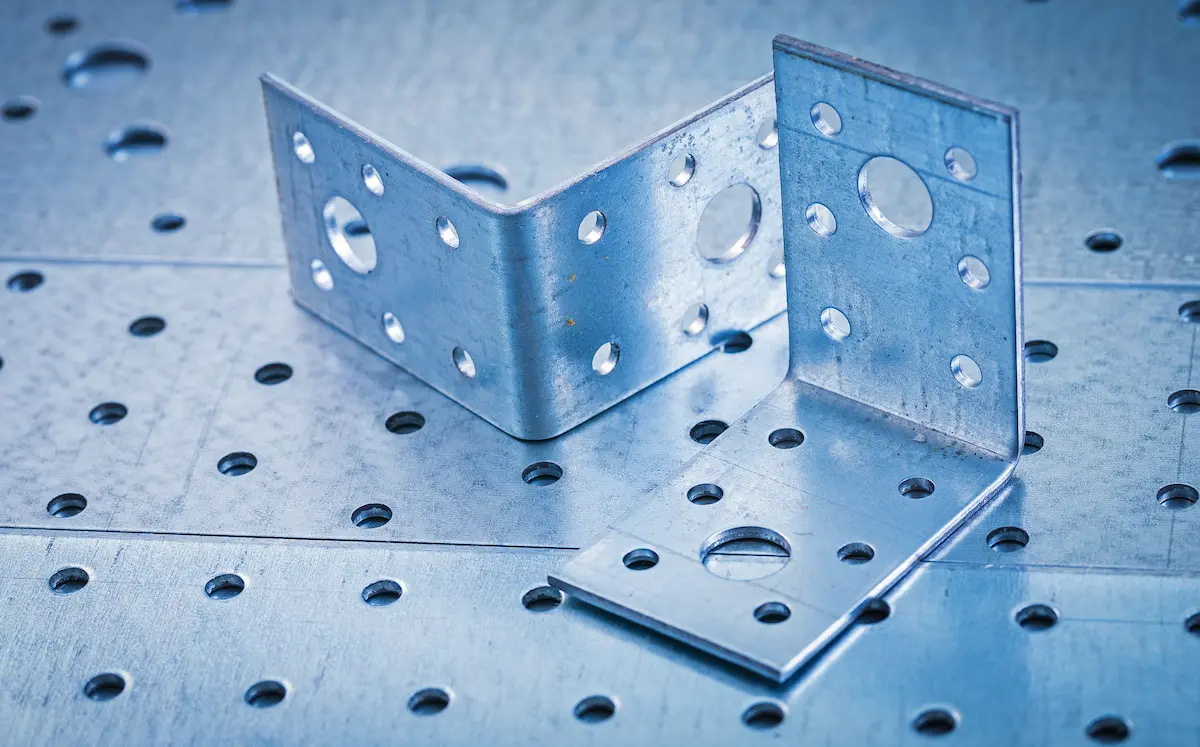
Sheet metal bending and drilling for technical components and profile panels
Combining sheet metal bending and drilling is never a simple juxtaposition of two machining operations. The sequence, the stiffness of the material, the location of the holes, and the direction of the bend decide the final stability of the part and its ability to hold tolerances. Many technical components, such as ventilated panels, lightweight casings, or structural profiles, arise from the need to have curved surfaces that are at the same time lightened or permeable, and in these contexts flat sheet metal does not behave like pre-machined sheet metal. It is the ability to anticipate the material’s behavior and set up a consistent process from start to finish that makes the difference.
Much of the sheet metal that is then cured and perforated comes from prior processing such as laser cutting, punching, or micro-tapping. Each previous stage leaves a “signature” on the rigidity of the part: a perforated sheet has a
When bending and drilling work really well together
The combination of the two processes works very well in numerous cases, especially when the part must provide rigidity and lightening at the same time. This is a frequent need in the fields of ventilation, technical architecture and industrial machine guards, where a panel must maintain a stable radius but also ensure air passage or weight reduction.
The most favorable contexts are those in which:
- the pattern of holes is regular and does not interfere with the bearing lines of the curve;
- thickness is adequate to support radius and progressive deformation;
- the required radius is large, so the sheet does not experience localized crushing;
- curve precedes further processing such as light bending or non-critical welding.
However, there are situations where the combination becomes delicate, such as in very dense patterns, in stamped panels with stiffeners, or in all surfaces that require tight curvature. In these cases, the drilling step can weaken strategic points in the sheet metal, and subsequent bending is likely to highlight this imbalance. Here the predictability of the process is more akin to what is observed in parts treated by deep drawing or deep deformation machining: an accurate reading of the development and a prior assessment of the actual behavior of the material is needed.
How a perforated sheet reacts during the bend
In perforated sheet metal, curvature is mainly influenced by the percentage of void. A surface with many holes deforms rapidly, while the fuller areas retain their original stiffness. It is this imbalance that generates curves that are not perfectly uniform, especially when the radius is tight or when the panel has holes with irregular pitch. Weaker bands tend to close sooner, creating micro-variations in radius that become apparent in assemblies or systems that require precise alignments.
The shape of the holes further defines how the sheet metal moves: round holes are the most stable, while squares or portholes tend to ovalize when the curvature is oriented along the weaker axis. If the pitch of the holes is very dense, the sheet metal may behave as a rigid mesh in some areas and as a soft surface in others. This combination creates a curve pattern that must be calibrated in several steps to avoid crushing or radius differences that cannot be recovered in subsequent steps.
An additional element to consider is springback. In solid sheet metal it is relatively predictable, but in perforated sheet metal it becomes erratic: the solid areas recover more radius, while the perforated areas hardly react. This difference generates twists that are imperceptible at the beginning but evident at the end of machining. The problem becomes even more pronounced when the part requires additional bending or must be precisely welded, as is the case in structures that concentrate stresses along the edges.
When trapezoidal sheet metal further complicates the curvature
Trapezoidal sheet metal carries with it a set of directional stiffnesses that heavily affect curvature. The ridges act as small beams that resist deformation, while the valleys yield first. This alternation means that, even with uniform pressure, the resulting radius is never perfectly homogeneous. The higher areas of the ridges react late, while the lower areas immediately follow the movement of the rollers.
The height of the frets and the pitch determine how complicated the curvature will be. High frets with narrow pitch generate a very stiff surface that tends to prevent beam closure, while lower frets with wide pitch fit more easily. The main risk is collapse of valleys or distortion of ridges, especially when the material is thin or when the curvature proceeds beyond half the useful height of the panel. In these cases, the direction of curvature must be defined upstream, based on the overall development of the part and the machining operations that will follow.
Sequence between drilling and bending in technical productions
The trickiest part, when combining drilling and bending, is deciding which of the two processes should come first. There is no one-size-fits-all rule: the choice depends on the hole pattern, thickness, and radius needed. Drilling first means you have a precise reference to follow in bending, but it exposes you to the risk of localized deformation. Bending earlier, on the other hand, allows the hole geometry to be preserved, as long as drilling is done with tools consistent with the new surface stiffness.
In productions where the part must maintain a high level of aesthetics, or when critical alignment of holes over the entire length is expected, the most stable sequence is often drilling → bending. But in engineering components involving tighter radii or variable geometries, the sequence reverses: first curving, then drilling the most sensitive areas. This is very similar to the logic found in designs that involve progressive deformation, as happens in post cold forming or mixed machining that combines bending and finishing.
When the two phases are not coordinated, the result is almost always the same: unstable radius, holes that lose circularity and visible deformations at the edges. In long panels or surfaces that need to rest on structural frames, this behavior becomes a serious problem, because the contact points no longer coincide with the dimensions provided in the initial development.
Parameters affecting the quality of curvature
Precision in curvature depends much more on the set-up than on the force applied. Too much pressure produces too tight a radius in the weaker areas, but too little pressure leaves an “open” curve in the stiffer bands. The result is an irregular shape that does not follow the set trajectory. This is why the bending of perforated and corrugated sheets is almost always done in incremental steps, progressively adjusting roller contact until a balance is found between solids and voids.
In thinner thicknesses the greatest risk is local collapse, while in thicker thicknesses you have to manage springback that varies along the surface. The same is true for the length of the panel: very extended pieces require continuous lateral supports, because deformation tends to be concentrated in the central part. Edge quality also has a great influence; uneven cutting, as happens in cases where the development has not been properly calibrated, amplifies the differences between one end and the other.
Frequent errors in combined drilling and bending machining
Some errors are common in workshops that treat perforated or profiled sheet metal as if it were flat sheet metal. The most common ones are easy to spot, but difficult to correct once the part has already undergone deformation:
- Holes too close to the edge with uneven failure during cornering;
- pattern incompatible with the required radius, especially on porthole or square holes;
- curvature in a single pass that does not allow the sheet to settle;
- Lack of supports in the long panels, collapsing the central areas;
- Incorrect operating sequence between drilling and bending, the main cause of unrecoverable ovalization.
The greatest difficulty lies in the fact that many defects emerge only after machining is complete: an uneven radius, a band that “pulls” to one side, or progressive deformation along the major axis. In parts that require precise welds, as also described in the typical approach to structures using MIG or TIG welding, these defects become impossible to compensate for without reworking the entire component.
Integrating bending and drilling into a coherent production cycle
When the two processes are approached as parts of a single process, the final quality improves significantly. A consistent cycle starts with development, goes through hole assessment, and continues with bending programmed on actual sheet metal behavior, not on a theoretical model. This is the same approach used in fabrications that require stiffness differences along the surface or that involve successive reinforcement steps through bending.
Realities that possess complete control of the supply chain (from laser cutting to punching, bending to finishing) are able to maintain greater consistency between stages. This avoids accumulated deviations, especially in panels that must be mounted on structures or integrated into mechanical systems. The advantage is not only the reduction in scrap, but also the ability to work on mixed batches while maintaining the same dimensional stability.
Flat, perforated and corrugated sheet metal
| Type | Stiffness | Minimum radius | Deformation | Operational Notes |
|---|---|---|---|---|
| Flat sheet metal | Homogeneous | Reduced | Uniform | Stable curvature with controlled transitions |
| Perforated sheet metal | Uneven | Variable | Possible ovalization | Requires multiple passes and frequent checks |
| Corrugated sheet metal | Very irregular | Wide | Distortions in ridges | To be bent with distributed pressures and calibrated directions |
Final quality and necessary controls
The quality of a curved and perforated component depends on its ability to maintain shape and preserve hole geometry. A sheet metal that has undergone uneven bending will immediately show differences in radius, while a perforated sheet metal with a sensitive pattern will show even minor ovalization. Therefore, in the most technical processes, three basic aspects are checked: radius uniformity, hole integrity and overall twist.
Quality control becomes even more important when the part must integrate with other machining operations, such as reinforcing bends, functional cuts, or welds, because a deformation not intercepted at this stage adds to subsequent ones, rendering the part unusable. In more mature production cycles, verification is integrated as early as bending, so that the roll path is corrected before the deviation becomes permanent.